06 กุมภาพันธ์ 2552

ความเป็นมาของกรุงเทพมหานคร


ราชอาณาจักรไทย ซึ่งมีประวัติศาสตร์สืบย้อนขึ้นไปได้กว่า ๘๐๐ ปี ได้มีการเปลี่ยนแปลงที่ตั้งของราชธานี อันเป็นศูนย์รวมของการปกครองและการบริหารราชการแผ่นดินมา ๔ ครั้งราชธานีแรกคือกรุงสุโขทัย ต่อมาคือกรุงศรีอยุธยา กรุงธนบุรี และกรุงรัตนโกสินทร์ในปัจจุบัน
โดยเฉพาะกรุงศรีอยุธยาอันมีนามเต็มว่า “กรุงเทพมหานคร บวรทวารวดีศรีอยุธยา มหาดิลกภพ นพรัตนราชธานี บุรีรมย์” นั้น มีนามสามัญอันปรากฏทั่วไปในพงศาวดาร จดหมายเหตุ หมายรับสั่ง ใบบอก สารตรา และเอกสาร สำคัญทางประวัติศาสตร์อื่น ๆ ว่า กรุงเทพมหานครบ้าง พระนครบ้าง ตลอดระยะเวลากว่า ๔๐๐ ปี ฉะนั้น ต่อมาแม้ราชธานีจะย้ายมาอยู่ที่กรุงธนบุรีก็ดี กรุงรัตนโกสินทร์ก็ดี คำเรียกราชธานีว่ากรุงเทพมหานคร หรือ พระนครนั้นก็ยังใช้สืบกันมาโดยตลอด
เมื่อพระบาทสมเด็จพระรามาธิบดีศรีสินทร มหาจักรีบรมนาถ พระพุทธยอดฟ้าจุฬาโลก ทรง สถาปนาราชธานีใหม่ ณ ฝั่งตะวันออกของ แม่น้ำ เจ้าพระยา เสร็จการฉลองพระนครแล้วจึงพระราชทานนามพระนครใหม่ เปลี่ยนแปลงจากครั้งกรุงศรีอยุธยาว่า“กรุงรัตนโกสินทร์อินท์ อโยธยา” ครั้นในรัชสมัยพระบาทสมเด็จพระรามาธิบดีศรีสินทรมหาเจษฎาธิบดินทร์ พระนั่งเกล้าเจ้าอยู่หัว ได้ทรงแก้นามพระนครเป็น “กรุงเทพมหานคร บวรรัตนโกสินท์ มหินทอยุธยา” ในรัชสมัยพระบาทสมเด็จพระปรเมนทรมหามงกุฎ พระจอมเกล้าเจ้าอยู่หัว ทรงเปลี่ยนคำว่า บวร เป็น อมร เปลี่ยนคำว่า มหินทอยุธยา โดยวิธีการสนธิศัพท์เป็น มหินทรายุธยา และเติมสร้อยนามต่อ ทั้งเปลี่ยนการสะกดคำ สินท์ เป็น สินทร์ ชื่อ กรุงรัตนโกสินทร์จึงมีนามเต็มว่า “กรุงเทพ มหานคร อมรรัตนโกสินทร์ มหินทรายุธยา มหาดิลกภพ นพรัตน์ราชธานีบูรีรมย์ อุดมราชนิเวศมหาสถาน อมรพิมานอวตารสถิต สักกทัตติยวิษณุกรรมประสิทธิ์” อันแปลได้ความว่า


กรุงเทพมหานครอมรรัตนโกสินทร์มหินทรายุธยามหาดิลกภพ นพรัตน์ราชธานีบูรีรมย์อุดมราชนิเวศมหาสถานอมรพิมานอวตารสถิตสักกทัตติยะวิษณุกรรมประสิทธิ์
พระนครอันกว้างใหญ่ ดุจเทพนครเป็นที่สถิตของพระแก้วมรกตเป็นมหานครที่ไม่มีใครรบชนะได้มีความงามอันมั่นคง และเจริญยิ่งเป็นเมืองหลวงที่บริบูรณ์ด้วยแก้วเก้าประการน่ารื่นรมย์ยิ่งมีพระราชนิเวศใหญ่โตมากมายเป็นวิมานเทพที่ประทับของพระราชาผู้อวตารลงมาซึ่งท้าวสักกเทวราชพระราชทานให้พระวิษณุกรรมลงมาเนรมิตไว้


มูลเหตุที่ราชธานีใหม่จะได้นามว่ากรุงรัตนโกสินทร์นั้น พระบาทสมเด็จพระปรมินทรมหาจุฬาลงกรณ พระจุลจอมเกล้าเจ้าอยู่หัว ทรงพระราชนิพนธ์ไว้ในเรื่องพระราชกรัณยานุสรณ์ว่า “การถือน้ำในแผ่นดินพระบาทสมเด็จพระพุทธยอดฟ้าจุฬาโลกนั้น ทรงพระราชศรัทธาเลื่อมใสมาก จึงได้ทรงสถาปนาพระอารามในพระบรมมหาราชวัง แล้วพระราชทานนามว่า วัดพระศรีรัตนศาสดาราม เชิญพระพุทธปฏิมากรมาประดิษฐานไว้บนบุษบกทองคำในพระอุโบสถ แล้วจึงพระราชทานนาม พระนครใหม่ให้ต้องกับการซึ่งมีพระพุทธมณีรัตนปฏิมากรแก้วมรกตพระองค์นี้เป็นศิริสำหรับ พระนคร… นามซึ่งว่า รัตนโกสินทร์ นั้น พระบาทสมเด็จพระจอมเกล้าเจ้าอยู่หัวท่านรับสั่งว่า เพราะท่านประสงค์ความว่า เป็นที่เก็บรักษาไว้ขององค์พระมหามณีรัตนปฏิมากรพระองค์นี้มาก จึงยกไว้เป็นหลักพระนคร พระราชทานนามพระนคร ก็ให้ต้องกับพระนามพระมหามณีรัตนปฏิมากรพระองค์นี้ด้วย เพราะฉะนั้น เมื่อถึงการพระราชพิธีถือน้ำพระพิพัฒน์สัจจาอันใหญ่นี้ จึงได้โปรดให้ข้าราชการมากระทำสัตย์สาบาน แล้วรับน้ำพระพิพัฒน์สัตยาเฉพาะพระพักตร์พระมหามณีรัตนปฏิมากร
คำว่า “กรุง” ตามสารานุกรมไทย ฉบับราชบัณฑิตยสถาน เล่ม ๑ หมายถึง “เมืองหลวงหรือเมืองใหญ่ซึ่งเป็นที่ประทับอยู่ประจำของพระมหากษัตริย์ หรือเป็นเมืองที่ตั้งสถานที่ทำการของรัฐบาล แต่ก่อนใช้ในความหมายว่า ประเทศ ก็มีเช่นคำว่า “กรุงสยาม”
อนึ่ง ตามพระบรมราชาธิบาย ในพระบาทสมเด็จพระปรเมนทรมหามงกุฎ พระจอมเกล้าเจ้าอยู่หัวมีว่า “คำว่า “กรุง” นี้ เดิมหมายความว่า “แม่น้ำ” โดยอรรถาธิบายว่า ผู้ใดมีอำนาจเหนือพื้นน้ำหรือเป็นเจ้าแห่งแม่น้ำตั้งแต่ปากน้ำไปจนถึงที่สุดของ แม่น้ำ ผู้นั้นก็ได้ชื่อว่าเป็นเจ้ากรุง แลเมืองที่ เจ้าพระองค์นั้นประทับอยู่ก็เลยเรียกว่า “กรุง” อย่างเมืองหลวงปัจจุบันนี้ เรียกว่า กรุงเทพฯ หรือกรุงเทพพระมหานคร ฉะนั้น”
ส่วนสมเด็จพระเจ้าบรมวงศ์เธอ เจ้าฟ้าฯ กรมพระยานริศรานุวัดติวงศ์ ทรงพระนิพนธ์ไว้ใน สาส์นสมเด็จว่า กรุงมิได้แปลว่า “เมือง” แต่แปลว่า จักรวรรดิ (Empire) มีประเทศราชน้อยใหญ่เป็นเมืองขึ้น มีใช้ในหนังสือเก่าเวลาออกพระนาม พระเจ้าจักรพรรดิ ออกต่อท้ายนามกรุงก็มี เช่น พระเจ้ากรุงสีพี เป็นต้น


History of Bangkok


Bangkok today widely is considered to be one of the most dynamic and colorful cities in Asia. Its history is no less a colorful transformation from a sleepy village to a fast-paced 21st century mega-city, with a modern city skyline. Bangkok has considerable cultural and historical signifi cance, from the early days of the “Rattanakosin Era” to its expansion in the nineteenth century. Bangkok’s evolution into the current regional hub of Asian came about while preserving the city’s unique soul and character, with its landmarks of temples and palaces that remain relatively unchanged over the years.

Interestingly, “Krung Thep” is an abbreviatedname of the city. Its full name is listed in theGuinness Book of World Records as the longestname of a place: Krungthep Maha NakhonAmon Rattanakosin Mahinthara Yutthaya Maha Dilok Phop Noppharat Ratchathani Burirom Udom Ratchaniwet Maha Sathan Amon PhimanAwatan Sathit Sakka Thattiya Witsanu KamPrasit.

“The city of angels, the great city, the eternal jewel city, the impregnable city of God Indra, the grand capital of the world endowed withnine precious gems, the happy city, abounding in an enormous royal palace that resembles the heavenly abode where reigns the reincarnated God, a city given by Indra and built by Vihnukarn”.

Bangkok’s origins can be traced back to when it was a small quiet seafront town of little importance on the bank of the Chao Phraya River, called Bang Makok (“village of olives”). The village eventually became a strategic location when a new canal shortened the distance of the winding section of the river to accommodate journeys from the splendor of the ancient capital Ayutthaya (the capital of Siam for over 400 years) to the sea. The excavation of this canal took place during the reign of King Chairachathiraj (1534-1546) and created two waterways running through the east and west of Bangkok.
Bangkok became a duty port for European ships, where visiting traders, explorers, missionaries, engravers, and writers from numerous nations arrived and were later received in Ayutthaya. During its height in the 17th century, the city of Ayutthaya prospered as a trading hub with a populace of over one million people, which at the time was larger than London.
Bangkok’s economy during the Ayutthaya period grew rapidly, due to being a port of entry, a business and service center and a major agricultural area with spectacular rice fields

and fruit orchards. Contacts with foreigners during their stay before reaching Ayutthaya resulted in the modern perspectives of the town, compared to other Thai towns. Following the devastation of Ayutthaya in 1767, Siam was subsequently liberated by King Taksin the Great, who established a new capital in the strategic town of Thonburi (currently part of Bangkok) on the west bank of the Chao Phraya river. When King Rama I ascended to the throne in 1782, he relocated the capital to the east bank of the Chao Phraya.
Bangkok became the offi cial capital of Siam in 1782 when the founder of the Chakri Dynasty, King Rama I, built his palace on the more defensible east bank of the Chao Phraya River and renamed the city “Krung Thep”, meaning the “City of Angels”. Thai people usually refer to the city as “Krung Thep”, while the name “Bangkok” is internationally recognized. King Rama I removed the Vichayen fortress and the wall on the eastern side of Thonburi, in order to make room for the expansion of the city.

New canals were dug during his reign, such as the Rob Krung canal and the Maha Nakorn canal. When the new capital city was being built,King Rama I was constantly thinkingof the welfare of the people. After digging canals for the defense of thecountry was completed, he orderedthe digging of the Mahanak canalstrictly for the people to use as awaterway.


โปรแกรม One Day Trip

การเดินทางท่องเที่ยวใน กรุงเทพมหาคร ที่สามารถไปไหนมาไหนได้หลายที่ภายในระยะเวลา 1 วัน เต็มที่กับการท่องเที่ยว ที่ให้ความรู้สึก อารมณ์ และบรรยากาศที่แตกต่างกันไป ท่านสสามารถที่จะเดินทางไปตามโปรแกรมที่เราจัดไว้ ซึ่งมีอยู่ 2 รูปแบบ 2 สไตล์ โดยเราจะเริ่มต้นกันที่โปรแกรมแรก คือ ..


โปรแกรม A เราจะเริ่มต้นด้วยการเดินทางไปเยี่ยมชมวัดพระศรีรัตนศาสดาราม และวัดในพื้นที่บริเวณใกล้เคียง หลังจากนั้นเราก็ไปนั่งรถรางชมรอบเกาะรัตโกสินทร์ เมื่อได้พักผ่อนหย่อนคลายไปกับบรรยากาศที่เป็นธรรมชาติและมีความงดงาม ซึ่งคงความเป็นไทยในสมัยก่อนแล้ว ก็ถึงเวลาที่เราจะไปพบกับค่ำคืนที่แสนงามของเมืองกรุงและเป็นแหล่งรวมชาวต่างชาติและผู้คนที่หลงใหลในบรรยากาศที่งดงามและแสนสนุกยามค่ำคืน และที่ที่เราพูดถึงก็คือ ถนนข้าวสาร ซึ่งเป็นถนนที่มีทั้งร้านอาหาร สถานที่ท่องเที่ยวยามราตรี และผู้คนที่นำสินค้าต่าง ๆ มาวางจำหน่าย


โปรกรม B ส่วนในโปรแกรมนี้เราจะไปเริ่มต้นกันที่สวนรถไฟ ซึ่งจะพบกับบรรยากาศที่แสนร่มรื่น และร่มเงาต้นไม้นานาชนิด ภายในนั้นเรายังสามารถเข้าไปชมความงามของผีเสื้อนานาพันธุ์ที่อุทยานผีเสื้อได้ด้วย หลังจากนั้นเราก็จะไปเดินกันต่อที่ ตลาดนัดสวนจตุจักรซึ่งมีของมากมายหลากหลายชนิด ไม่ว่าจะเป็นเสื้อผ้า สัตย์ ของประดับตกแต่งบ้าน และรวมไปถึงผลิตภัณฑ์ OTOP น้ำว่านหางจระเข้และสินค้าอื่น ๆ อีกมาย และเราก็จะนั่งรถไฟฟ้าไปเดินท่องเที่ยวต่อกันที่ สยาม ซึ่งเป็นแหล่งศูนย์รวมของคนทุกเพศทุกวัย ณ ที่นี้เรารวมไปถึงชาวต่างชาติด้วย และยังเป็นสถานที่ที่ผู้คนชอบไปช็อปปิ้ง เพราะที่นั่นเป็นแหล่งศูนย์รวมแฟชั่นต่าง ๆ ต่อจากนี้เราก็ยังสามารถไปกันต่อได้อีก ไม่ว่าจะเป็นการเดิน หรือการนั่งรถไฟฟ้าไป สถานที่ที่เราได้กล่าวถึงนั้นก็คือ Central World ซึ่งเป็นศูนย์การค้าชื่อดังอีกแห่งที่มีของชั้นนำมากมายวางจำหน่ายที่นี่ และมีร้านอาหารที่มีบรรยากาศดีมากมายให้ท่านได้เลือกตามใจชอบ และโปรแกรมสุดท้ายของวันนี้ก็คงจะหนีไม่พ้นกับการท่องราตรีที่ Escudo ซึ่งมีบรรยากาศที่ดี มีเพลงเพราะ ๆ มันส์ ๆ ให้ท่านได้ฟังและเต้นตามที่ท่านชอบพร้อมกับเครื่องดื่มและอาหารอีกมายที่ท่านรอท่านอยู่ในค่ำคืนนี้


แต่ละโปรแกรมท่านสามารถเลือกไปได้ตามความสะดวกและความพึงพอใจ ท่านจะได้รับความสะดวกสบายและความปลอดภัยไปพร้อมกับโปรแกรมการท่องเที่ยวที่ทางเราจัดเตรียมไว้ ...

พระบรมมหาราชวังและวัดพระศรีรัตนศาสดาราม

The Grand Palace


พระบาทสมเด็จพระพุทธยอดฟ้าจุฬาโลกมหาราช ทรงสร้างขึ้นพร้อมสถาปนากรุงรัตนโกสินทร์ เมื่อแรกสร้างประกอบด้วย 3 ส่วน คือ พระมหาปราสาท พระราชมณเฑียรสถาน และวัดพระศรีรัตนศาสดาราม มีเนื้อที่ 132 ไร่ ในอดีตพระบรมมหาราชวังเป็นที่ประทับของพระมหากษัตริย์ ลักษณะแบบแผนการก่อสร้างคล้ายคลึงกับพระบรมมหาราชวังเก่าในสมัยกรุงศรีอยุธยาคือ มีวัดพระศรีรัตนศาสดารามอยู่ในบริเวณวังเหมือนกับวัดพระศรีสรรเพชญ์ในสมัยกรุงศรีอยุธยา ต่อมาในสมัยรัชกาลที่ 4 และรัชกาลที่ 5 เริ่มรับอิทธิพลจากตะวันตกทำให้สถาปัตยกรรมมีลักษณะผสมผสานกับทางตะวันตกมากขึ้นหมู่พระที่นั่งที่สำคัญมีดังนี้

พระที่นั่งดุสิตมหาปราสาท เดิมชื่อพระที่นั่งอินทราภิเษกมหาปราสาท เป็นพระมหาปราสาท องค์แรกที่สร้างขึ้นในพระราชวัง เป็นที่ประดิษฐานพระบรมศพพระมหากษัตริย์ สมเด็จพระอัครมเหสี และพระบรมวงศานุวงศ์ใช้ประกอบพระราชพิธีสำคัญ เช่น พระราชพิธีการมงคล และบำเพ็ญพระราชกุศลต่างๆ

พระที่นั่งอาภรณ์พิโมกข์ปราสาท อยู่ใกล้กับพระที่นั่งดุสิตมหาปราสาทใช้เป็นที่ประทับทรงพระราชพาหนะ และประทับเปลื้องเครื่องในงานพระราชพิธีที่มีขบวนแห่

.พระที่นั่งพิมานรัตยา สร้างเมื่อ พ.ศ. 2332 ในสมัยพระบาทสมเด็จพระมงกุฎเกล้าฯ เจ้าอยู่หัว ทรงใช้เป็นที่บรรทม และทรงใช้เป็นที่ชุมนุมมหาสมาคมสำหรับพระบรมวงศานุวงศ์ และข้าราชบริพารฝ่ายในเข้ารับพระราชทานเครื่องอิสริยยศ และเครื่องราชอิสริยาภรณ์ นอกจากนี้ยังเป็นที่สรงน้ำพระบรมศพพระบรมวงศานุวงศ์ก่อนที่จะประดิษฐานพระบรมโกศในพระที่นั่งดุสิตมหาปราสาท

พระที่นั่งจักรีมหาปราสาท สร้างในสมัยรัชกาลพระบาทสมเด็จพระจุลจอมเกล้าฯ เจ้าอยู่หัว เมื่อ พ.ศ. 2419 ใช้เป็นที่รับรองพระราชอาคันตุกะชั้นพระราชาธิบดี หรือชั้นประมุขของรัฐ นอกจากนี้ยังมีหมู่พระที่นั่งสำคัญอื่นๆ เช่น พระที่นั่งราชกรัณยสภา พระที่นั่งมูลสถานบรมอาสน์ พระที่นั่งบรมราชสถิตย์มโหฬาร พระที่นั่งจักรพรรดิพิมาน พระที่นั่งไพศาลทักษิณ ฯลฯ

วัดพระศรีรัตนศาสดาราม หรือ วัดพระแก้ว เป็นพระอารามหลวง ตั้งอยู่ตรงมุมด้านตะวันออกเฉียงเหนือของพระบรมมหาราชวัง เป็นที่ประดิษฐานพระมหามณีรัตนปฏิมากร (พระแก้วมรกต) และใช้เป็นที่ประกอบพระราชพิธีทางศาสนาที่สำคัญ วัดพระแก้วสร้างแล้วเสร็จในปี พ.ศ. 2327 และได้รับการบูรณะปฏิสังขรณ์มาตั้งแต่สมัยรัชกาลที่ 1-9 ตลอดทุกรัชกาล ภายในพระอุโบสถ และระเบียงรอบวัดมีภาพจิตรกรรมฝาผนังสวยงามมาก สิ่งที่น่าสนใจอื่นๆ ภายในวัดได้แก่ พระปรางค์ 8 องค์ พระศรีรัตนเจดีย์ ปราสาทนครวัดจำลอง ปราสาทพระเทพบิดร ฯลฯ
ศาลาเครื่องราชอิสริยยศ และเหรียญกษาปณ์ ตั้งอยู่ภายในบริเวณพระบรมมหาราชวังด้านขวามือก่อนถึงทางเข้าพระราชวังส่วนใน จัดแสดงเหรียญกษาปณ์ และเงินตราที่ใช้ในประเทศไทยรวมทั้งเครื่องราชอิสริยาภรณ์ของสำนักฝ่ายใน เปิดให้เข้าชมทุกวัน ตั้งแต่เวลา 08.30–16.00 น. ค่าเข้าชม 10 บาท สอบถามเพิ่มเติมได้ที่ส่วนจัดแสดง โทร. 0 2222 5864 ต่อ 18

พระบรมมหาราชวังเปิดให้เข้าชมทุกวัน ตั้งแต่เวลา 08.30–15.30 น. ชาวไทยไม่เสียค่าเข้าชม สำหรับชาวต่างประเทศเสียค่าเข้าชม ***250 บาท ซึ่งรวมบัตรเข้าชมศาลาเครื่องราชอิสริยยศและเหรียญกษาปณ์ และค่าเข้าชมพระที่นั่งวิมานเมฆ สอบถามเพิ่มเติมที่ โทร. 0 2224 3273 หรือ 0 2623 5500 ต่อ 3100 หรือ http://www.palaces.thai.net/


The Grand Palace

Every visitor to Bangkok should see the magnificent buildings within the Grand Palace compound to get a feeling of the grandeur architectural style.Since the founding of Bangkok as the Nations capital by King Rama I, The Grand Palace has been the major architectural symbol of The Thai Royal Family. In the present time, The Royal Family resides at Chitralada Palace while The Grand Palace is used for ceremonial purposes.


Every visitor to Bangkok should see the magnificent buildings within the Grand Palace compound to get a feeling of the grandeur architectural style.

Since the founding of Bangkok as the Nations capital by King Rama I, The Grand Palace has been the major architectural symbol of The Thai Royal Family. In the present time, The Royal Family resides at Chitralada Palace while The Grand Palace is used for ceremonial purposes.

The main buildings within the Grand Palace compound were built for King Rama V, who was the first Thai King to travel to Europe.

Phra Thinang Chakri Maha Prasat, built in 1877 by King Rama V as his Royal Residence, is the most highly recognized architectural landmark of the Nation. The central Throne Hall, which was formerly used for the reception of foreign envoys, is flanked by reception areas decorated with galleries of portraiture. The central room on the second floor is used as a shrine for the reliquary ashes of Kings Rama IV, Rama V, Rama VI, Rama VII and Rama VIII.

Borom Phiman Mansion was also constructed during the reign of King Rama V. When his son, King Rama VI ascended to the throne, he had it improved for use as his residence. The three succeeding Kings also resided here at one time or another.

The Siwalai Gardens, where the office of The Royal Household Bureau is located, were used for receptions as well as a recreation area for the royal women and children.

Maha Monthien Prasat houses The Audience Hall of Amarin Winitchai where ceremonies of the Court usually take place in front of the throne surmounted by its canopy of nine tiers of white cloth.

How to go there:The most enjoyable route is to take the BTS Skytrain to Taksin Station. From here take a Chao Phraya River Express boat to Tha Chang Wang Luang Pier. It is a short walk from the pier to the entrance to The Grand Palace public entrance.

Opening Hours: Open to the public everyday, except during special Royal Ceremonies, from 8.30 a.m. to 3.30 p.m.


Admission Fee: ***Baht 250. This also includes admission to Wat Phra Kaeo, The Royal Thai Decorations & Coins Pavilion in the same compound and to Vimanmek Mansion Museum on Ratchawithi Road. Baht 100. for rental personal audio guide in English, French, German, Spanish, Russian, Japanese or Mandarin. ( Please be informed that from July 1,2008 the admission fee will be Baht 300 and including admission to visit "the exhibition of Art of Kingdom" at Anantasamakom Throne Hall and from Jan 1,2009 the admission fee will be Baht 350)
Dress Code: Visitors are required to dress appropriately. Thus the following dress - code (applicable to both ladies and gentlemen) is requested:
1. Shorts, mini-skirts, short skirts, tight fitting trousers, as well as tights can not be worn as outer garments.
2. See-through shirts and blouses, as well as culottes or quarter length trousers can not be worn.
3. Sleeveless shirts or vests can not be worn as outer garments.
4. Sandals (without ankle or heel straps) can not be worn.
5. All shirt sleeves, whether long or short, can not be rolled up.
6. Sweat shirts and sweat pants, wind-cheaters, pajamas and fisherman trousers can not be worn.

Contacts: Tel : 0 2623 5500 ext.3100, 0 2224 3273
Website : www.palaces.thai.net
Nearby Places/Attractions: Tha Chang Pier , Wat Pho, Wat Arun, National Museum


พระบรมรูปทรงม้า

The Equestrian Statue of King Rama V the Great


พระบรมรูปทรงม้า สร้างขึ้นในรัชสมัยของพระบาทสมเด็จพระจุลจอมเกล้าเจ้าอยู่หัว เมื่อ พ.ศ. 2451 ด้วยเงินที่ประชาชนได้เรี่ยไรสมทบทุน โดยจ้างนายช่างชาวฝรั่งเศสแห่งบริษัท ซุซ เซอรเฟรส ฟองเดอร์ หล่อมาจากกรุงปารีส ส่วนเงินที่เหลือพระบาทสมเด็จพระมงกุฎเกล้าเจ้าอยู่หัวทรงนำไปใช้สร้างมหาวิทยาลัยขึ้น มีนามตามพระปรมาภิไธยว่า "จุฬาลงกรณ์มหาวิทยาลัย"


Established in 1908 in the reign of King Rama V with a fund raised by the Thai people, the statue was cast in Paris by a French craftsman. The remaining fund was spent by King Rama VI on the establishment of Chulalongkorn University, which was named after King Rama V.

Open : Daily
Admission : Free


ศาลหลักเมือง


ตั้งอยู่บริเวณใกล้เคียงกับวัดพระศรีรัตนศาสดาราม เมื่อจะสร้างบ้านเมืองต้องมีการฝังเสาหลักเมือง ซึ่งเป็นประเพณีเก่าแก่ของชาติไทย รัชกาลที่ 1 ทรงโปรดเกล้าฯ ให้จัดการพระราชพิธีฝังเสาหลักเมืองกรุงเทพฯ เมื่อวันอาทิตย์ที่ 21 เมษายน พ.ศ. 2325 บรรจุดวงชะตาของกรุงเทพฯ ไว้ภายใน เสาหลักเมืองเดิมทำด้วยไม้ชัยพฤกษ์ เส้นผ่าศูนย์กลาง 75 เซนติเมตร สูง 27 เซนติเมตร แต่สร้างใหม่ในรัชกาลที่ 4 แทนของเดิมที่ชำรุด เป็นไม้ชัยพฤกษ์สูง 108 นิ้ว ฐานเป็นแท่นกว้าง 70 นิ้ว ตั้งอยู่ภายในอาคารยอดปรางค์อย่างที่เห็นในปัจจุบัน ภายในศาลหลักเมืองยังมีเทวรูปสำคัญ คือ เทพารักษ์ เจ้าพ่อหอกลอง พระเสื้อเมือง พระทรงเมือง เจ้าพ่อเจตคุปต์ และพระ


The City Pillar Shrine

According to an old Thai tradition, a city pillar had to be built upon the establishment of a new city. King Rama I had the Bangkok city pillar erected near the Temple of the Emerald Buddha on Sunday, 21 April, 1782, with the citys horoscope inside. The original pillar was made of cassia wood known as Chaiyaphruek, measuring 75 cm. in diameter and 27 cm. high. In the reign of King Rama IV, the old dilapidated pillar was replaced by a new one made of the same kind of wood, measuring 270 cm. high and standing on a base of 175 cm. wide, sheltered by a Prang-shaped shrine as it appears today. The shrine also houses images of protective deities including Thepharak, Chaopho Ho Klong, Phra Suea Mueang, Phra Song Mueang, Chaopho Chetakhup and Phra Kan Chai Si.


According to an old Thai tradition, a city pillar had to be built upon the establishment of a new city. King Rama I had the Bangkok city pillar erected near the Temple of the Emerald Buddha on Sunday, 21 April, 1782, with the citys horoscope inside. The original pillar was made of cassia wood known as Chaiyaphruek, measuring 75 cm. in diameter and 27 cm. high. In the reign of King Rama IV, the old dilapidated pillar was replaced by a new one made of the same kind of wood, measuring 270 cm. high and standing on a base of 175 cm. wide, sheltered by a Prang-shaped shrine as it appears today. The shrine also houses images of protective deities including Thepharak, Chaopho Ho Klong, Phra Suea Mueang, Phra Song Mueang, Chaopho Chetakhup and Phra Kan Chai Si.

Open : Daily from 07.00-18.00 hrs.

วัดไตรมิตรวิทยาราม


อยู่ที่ถนนเจริญกรุง (ใกล้หัวลำโพง) เดิมชื่อว่า "วัดสามจีน" ภายในวัดมีพระพุทธรูปปูนปั้นองค์หนึ่ง เมื่อคราวเปลี่ยนที่ตั้ง ปูนที่หุ้มอยู่ได้กะเทาะออก เห็นภายในเป็นพระพุทธรูปทองคำ ลักษณะองค์พระเป็นศิลปะสุโขทัยจึงได้ถวายพระนามว่า "พระสุโขทัยไตรมิตร" เป็นพระพุทธรูปทองคำที่มีส่วนผสมของทองคำสูงมาก เรียกว่า "ทองเนื้อเจ็ดน้ำสองขา" มีขนาดหน้าตักกว้าง 6 ศอก 5 นิ้ว สูง 7 ศอก 1 คืบ 9 นิ้ว


Wat Trai Mit

Have you ever seen five and a half tons of goldω Wat Trai Mit, near the Bangkok Railway Station at Hua Lamphong, is home to the famous Golden Buddha which is 3 metres high.

The Golden Buddha is believed to be 700 to 800 years old as it is in the Mara attitude, typical of the Sukhothai era. It was installed at Wat Phrayakrai in the Yannawa area of Bangkok during the reign of King Rama III where it stayed until 1931.

The temple had fallen out of use and was abandoned so the Ecclesiastical Commission had it relocated at Wat Trai Mit. At this time, no one seemed to know that it was made of pure gold.

Then in 1955, Reverend Phra Visutha-thibordee, the presiding abbot at the temple had supervised the construction of the temple building to house the Buddha. When it was being moved into its new position, the covering plaster was damaged revealing what was inside - Buddha image cast in 18 carat gold.

It is believed that the original Golden Buddha was disguised under the plaster covering to hide it from enemies during the Ayutthaya period. Photographs of different stages of the plaster removal are displayed in the Wihan.

Location: near Chinese Gate, Chinatown area, Yaowarat road
How to get there : take Metro to Hua Lamphong MRT Station and continue walking for 300 metres or Bus routes 4, 7, 21, 25, 501
Open : Daily from 8 a.m. - 5 p.m.
Admission : 20 baht
Tel : 0 2225 9775


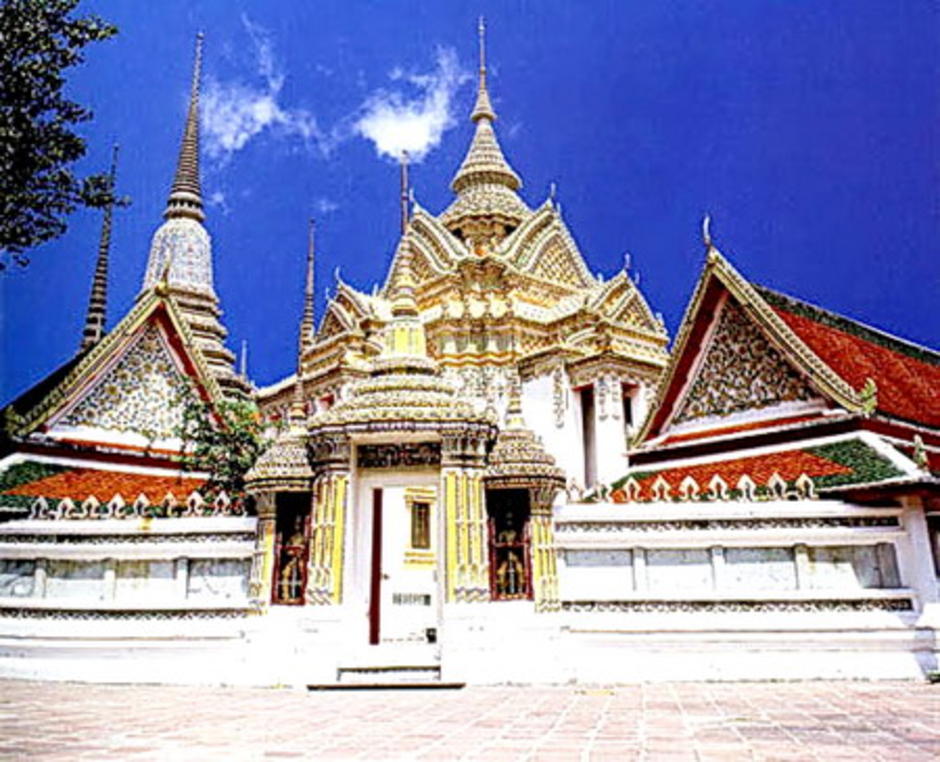
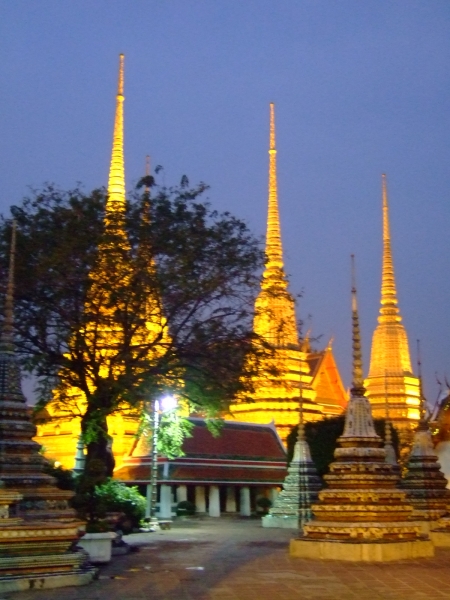
วัดพระเชตุพนวิมลมังคลาราม (วัดโพธิ์)


วัดพระเชตุพนวิมลมังคลาราม (วัดโพธิ์) อยู่ที่ถนนสนามไชย ข้างพระบรมหาราชวัง เป็นวัดเก่าแก่ซึ่งพระบาทสมเด็จพระพุทธยอดฟ้าจุฬาโลกมหาราช โปรดเกล้าฯ ให้สร้างขึ้นเพื่อให้พระภิกษุสงฆ์ได้เล่าเรียนพระปริยัติธรรม วัดนี้ถือเป็นวัดประจำรัชกาลที่ 1 ครั้นถึงสมัยพระบาทสมเด็จพระนั่งเกล้าเจ้าอยู่หัวได้โปรดเกล้าฯ ให้บูรณะวัดโพธิ์ใหม่ทั้งหมด และได้นำเอาตำราวิชาการด้านต่างๆ มาจารึกไว้โดยรอบ เพื่อเป็นการเผยแพร่ความรู้แก่ประชาชน ถือได้ว่าวัดโพธิ์เป็นมหาวิทยาลัยแห่งแรกของไทย นอกจากนี้ที่วัดโพธิ์ยังมีพระพุทธไสยาสน์องค์ใหญ่สร้างในสมัยรัชกาลที่ 3 ก่ออิฐถือปูนปิดทองทั้งองค์ ยาว 46 เมตร สูง 15 เมตร ที่ฝ่าพระบาทแต่ละข้างมีลวดลายประดับมุกเป็นภาพมงคล 108 ประการ อันเป็นลักษณะอย่างหนึ่งของมหาบุรุษตามคติของอินเดีย เปิดทุกวันตั้งแต่เวลา 08.00 – 18.00 น. ไม่เสียค่าเข้าชมสำหรับชาวไทย ชาวต่างชาติคนละ 50 บาท ต่อสอบถามรายละเอียดเพิ่มเติมได้ที่ โทร. 0 2222 5910, 0 2226 2942, 0 2226 1743, 0 2225 9595

หมายเหตุ ในวันที่ 31 มีนาคม2551นี้ จารึกวัดโพธิ์ จะได้รับประกาศนียบัตรรับรองให้เป็น " มรดกแห่งความทรงจำแห่งโลก (Memory of the World) จากองค์การศึกษาวิทยาศาสตร์ และวัฒนธรรมแห่งสหประชาชาติ หรือ องค์การยูเนสโก (UNESCO)


Wat Pho

This is possibly the most interesting temple in Thailand as it combines history, medical science and is a center for meditaion and traditional massage training. Its official name is Wat Phrachetuphon Vimon Mangkararam Ratchaworamahawihan, although it is commonly called Wat Po. Founded during the 16th century, Wat Pho is most famous for the golden reclining Buddha that measues 46 metres and has feet inlaid with mother-of pearl. This is the main attraction that draws visitors to the temple. In more modern times, Wat Pho has gained international recognition as a meditation centre and for the traditional Thai massage that is both practiced and taught here.Traditionally, temples were the schools as there was no formal education system, with monks providing basic lesson in both spiritual and secular subjects. King

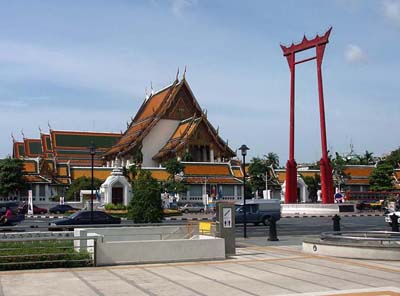
วัดสุทัศน์เทพวราราม และเสาชิงช้า

Wat Suthat and the Giant Swing


เสาชิงช้า ตั้งอยู่หน้าวัดสุทัศน์เทพวราราม บนถนนบำรุงเมือง เขตพระนคร เสาชิงช้าถูกสร้างขึ้นครั้งแรกในปี 2327และถือเป็นโบราณสถานของชาติตั้งแต่ปี พ.ศ.2492 เป็นเสาชิงช้าขนาดใหญ่ มีสีแดงชาด มีส่วนสูงประมาณ 21 เมตร เนื่องจากเสาชิงช้ามีอายุการใช้งานมานานและสภาพชำรุดมาก จึงได้ทำการบูรณะปฎิสังขรณ์เสาชิงช้าใหม่โดยใช้ไม้สักทองที่มีลำต้นขนาดใกล้เคียงเสาชิงช้าเดิมจำนวน 6 ต้นจากจังหวัดแพร่ และดำเนินการแล้วเสร็จในปี 2549
ในสมัยรัชกาลที่ 1 เมื่อสร้างกรุงเทพฯ เสร็จแล้วได้โปรดให้มีการสร้างโบสถ์พราหมณ์ และเสาชิงช้า บริเวณริมถนนบำรุงเมือง ทางจะเลี้ยวไปถนนดินสอ ตั้งแต่ปี พ.ศ. 2327 และต่อมาในสมัยรัชกาลที่ 5 ได้ย้ายมาตั้งที่ถนนบำรุงเมืองในตำแหน่งนี้จนถึงปัจจุบัน ต่อมาในสมัยรัชกาลที่ 6 บริษัท หลุยส์ ที.เลียวโนแวนส์ ซึ่งเป็นบริษัทค้าไม้ได้อุทิศซุงไม้สักเพื่อสร้างเสาชิงช้าใหม่ เมื่อวันที่ 12 เมษายน พ.ศ. 2463 และ มีการซ่อมใหม่ เมื่อ พ.ศ. 2502 และมีการเปลี่ยนเสาใหม่โดยคงไว้ในลักษณะเดิมในปี พ.ศ. 2513 จากนั้นก็ยังไดัรับการซ่อมแซมบูรณะอีกหลายครั้ง จนกระทั่งปีพ.ศ.2548 เสาส่วนกลางมีความชำรุดมากและเนื่องด้วยเสาชิงช้าเป็นโบราณสถานของกรมศิลปากร ทางกรุงเทพมหานครฯ จึงได้ทำหนังสือขออนุญาตกรมศิลปากร เพื่อดำเนินการเปลี่ยนเสาใหม่ทั้งหมด ดังที่เห็นในปัจจุบัน และในอดีตเสาชิงช้านี้เคยใช้ประกอบพิธีตรียัมปวาย หรือพิธีโล้ชิงช้าในศาสนาพราหมณ์ เพื่อเป็นการแสดงถึงการต้อนรับพระอิศวรในการเสด็จลงสู่โลกมนุษย์ในเดือนยี่ของทุกปี แต่ต่อมาพระราชพิธีนี้ได้ถูกยกเลิกในสมัยรัชกาลที่ 7 ปี พ.ศ. 2478


A visit to Wat Suthat Thep Wararam, situated almost in the center of old Bangkok, gives you an opportunity to see both the Giant Swing and one of the first-class Royal temples. The surrounding area is also worth exploring as there are many shops selling religious items.

The building of the temple was commissioned by King Rama I, the founder of Bangkok, in 1807. Its location in the center of Rattanakosin Island. This was in keeping with the Buddhist belief that it is like Mount Phra Sumeru being the center of the universe. Phra Sri Sakayamunee, the principal Buddha image, was moved from Wat Mahathat in Sukhothai to be placed in Phra Wihan Luang in Wat Suthat in 1808.

Wat Suthat is surrounded by an impressive wall 1.94 metres high and 0.85 metres thick. There are a total of 15 doorways leading into the temple compound. Within the temple grounds the most important building is the Phra Wihan Luang which is the Royal Temple. The mural paintings, covering all the interior walls are some of the finest to be seen anywhere. Each has stone inscriptions describing the pictures.

Surrounding the Royal Temple is Phra Wihan Khot terrace which is really impressive with 156 Buddha statues, mostly in the seated meditative attitude called Smathi.

The chapel, Phra Ubosot at Wat Suthat is possibly the most beautiful in Thailand and is also the largest measuring 72.25 metres in length and 22.60 metres in width.

There are four pavilions (sala) within the compound that are elevated to the height of the temples walls. These are used for various royal functions and for viewing the previous functions at the Giant Swing in front of the temple.

The annual ceremony was held up until the 1930s but was discontinued to the high fatality rate as young men tried to swing high enough to grab a sack of gold on a pole about 25 metres in the air.

How to get there : Bus routes 12, 15, 42, 73, 96, 508
Open daily : 8.30 am. to 9.00 pm.
Admission fee : Baht 20
Contact : Tel: 02 224 9845
Website : www.watsuthat.org
Nearby Places/Attractions: Democracy Monument, Golden Mountain


วัดสระเกศ (ภูเขาทอง)

Wat Sa Ket and The Golden Mount


อยู่นอกกำแพงเมือง ริมคลองมหานาค ตรงที่บรรจบกับคลองบางลำพู เดิมเป็นวัดเก่าชื่อว่า "วัดสะแก" ได้รับการสถาปนาขึ้นใหม่ทั้งพระอารามในสมัยรัชกาลพระบาทสมเด็จพระพุทธยอดฟ้าจุฬาโลก และพระราชทานนามว่า "วัดสระเกศ" ส่วนเจดีย์ภูเขาทองนั้นเริ่มสร้างในสมัยพระบาทสมเด็จพระนั่งเกล้าเจ้าอยู่หัวโดยทรงเลียนแบบมาจากภูเขาทองในสมัยกรุงศรีอยุธยาแล้วเสร็จในรัชกาลพระบาทสมเด็จพระจุลจอมเกล้าเจ้าอยู่หัวได้รับพระราชทานนามว่า “สุวรรณบรรพต” มีความสูง 77 เมตร บนยอดสุวรรณบรรพตเป็นที่ตั้งของพระเจดีย์บรรจุพระบรมสารีริกธาตุที่ขุดค้นพบที่เมืองกบิลพัสดุ์ และพิสูจน์ได้ว่าเป็นของพระสมณโคดมซึ่งเป็นส่วนแบ่งของพระราชวงศ์ศากยราชเพราะมีคำจารึกอยู่ พระองค์เจ้าปฤษฎางค์ขณะนั้นกำลังทรงผนวชอยู่ที่ประเทศอินเดีย ได้ส่งพระบรมสารีริกธาตุเข้ามาถวายในฐานะที่พระมหากษัตริย์ไทยทรงเป็นกษัตริย์เพียงพระองค์เดียวที่เป็นพุทธมามกะอยู่ในขณะนั้น เปิดให้เข้าชมตั้งแต่เวลา 07.30 – 17.30 น.


This landmark, on the only hill in Bangkok, is of great significance for all followers of The Lord Buddha. 320 stairs take you up to the top for panoramic views of the Rattanakosin Island.

The Golden Mount is on a man-made hill with a diameter of 500 metres and soars 100 metres to the sky. There was a small chedi on this site and after it collapsed, King Rama III commissioned the constructed of a much larger one which was completed during the reign of King Rama V.

In 1877, King Rama V brought the Buddha relic in the custody of the Royal Chakri family from the Grand Palace to the Royal Pavilion at Wat Saket. It was then enshrined in the in the pagoda on top of the Golden Mount.

Two decades later, Marquis Curzon, the British Viceroy of India, presented more Buddha relics near the Nepalese border to King Rama V. These were enshrined in a bronze pagoda in 1899 and installed on the top of the Golden Mount.

The temple, Wat Saket, was built during the reign of King Rama I and is the location for a festival each November that includes a climb to the top of the Golden Mount.

How to get there : Bus route 15, 37, 47, 49
Open daily : 7.30 am. - 5.30 pm.
Admission : 10 baht
Tel : 0 2621 0576
Nearby Places/Attractions: Wat Ratchanatdaram, Democracy Mounment, Wat Suthat

05 กุมภาพันธ์ 2552

วัดอรุณราชวราราม


ตั้งอยู่ที่ถนนอรุณอัมรินทร์ เขตบางกอกใหญ่ ริมแม่น้ำเจ้าพระยาฝั่งธนบุรี ตรงข้ามกับวัดโพธิ์ ข้ามเรือได้ที่ท่าเตียน เป็นวัดที่มีมาตั้งแต่ครั้งสมัยกรุงศรีอยุธยา เดิมชื่อว่า “วัดแจ้ง” ต่อมาเมื่อพระเจ้ากรุงธนบุรีย้าย ราชธานีจากกรุงศรีอยุธยามาตั้ง ณ กรุงธนบุรี ได้โปรดเกล้าฯ ให้กำหนดเอาวัดแจ้งเป็นวัดในเขตพระราชฐานใช้เป็นที่ประดิษฐานพระแก้วมรกตที่ได้อัญเชิญมาจากเวียงจันทน์ วัดนี้ได้รับการบูรณะปฏิสังขรณ์ครั้งใหญ่ในสมัยรัชกาลที่ 2 จึงถือเป็นวัดประจำรัชกาลที่ 2 เมื่อบูรณะเสร็จแล้วได้พระราชทานนามว่า “วัดอรุณราชธาราม” ในสมัยรัชกาลที่ 3 มีการก่อสร้างพระปรางค์องค์ใหญ่ซึ่งมีความสูงถึง 67 เมตร แต่มาเสร็จสมบูรณ์ในสมัยรัชกาลที่ 4 และได้เปลี่ยนชื่อเป็น “วัดอรุณราชวราราม”
เปิดให้เข้าชมทุกวันระหว่างเวลา 7.30 - 17.30 น. ผู้ประสงค์จะเข้าชมในพระอุโบสถต้องทำหนังสือขออนุญาตล่วงหน้าถึงเจ้าอาวาสวัดอรุณฯ
การเดินทาง สามารถใช้เรือโดยสารข้ามฟากจากท่าเตียน หรือท่าวัดโพธิ์ ไปยัง ท่าวัดอรุณ
Wat Arun

Make sure you set aside one late afternoon to see and photograph this imposing sight at sunset with the Chao Phraya River in the foreground. These photographs will bring back beautiful memories of Bangkok. The temple was built during the Ayutthaya period and was originally called Wat Makok after the name of the local village Tambol Bangmakok. It means "Village of Olives". Wat Arun gets its name from Aruna, the Indian god of the dawn, hence its common name The Temple of Dawn. The location of the temple is in the area that used to be occupied by the palace of King Taksin who re-established the Siamese Kingdom after the fall of Ayuttaya more than two hundred years ago. The main Buddha image is believed to have been designed by King Rama II. Wat Arun, often called The Temple of Dawn, is one of the most remarkable visual identities of Bangkok. The imposing Khmer-style prang or tower is 104 metres tall and decorated with bits of porcelain that was used as ballast by boats coming from China. It is surrounded by four smaller prangs. Construction of the prangs were started by King Rama II and completed by King Rama II. The central balcony is an ideal spot for looking across the river to The Grand Palace and The Temple of The Emerald Buddha. Each year at the end of the three-month lent period for Buddhist monks, H. M. The King or his appointed representative travels down river in a Royal Barge Procession to present new robes to the monks. This ceremony is called Royal Tod Kathin. How to get there: Bus routes 19, 57, 83 Open daily: 7.30 am. to 5.30 pm. Admission fee: Baht 20 Contact: Tel: 0 2465 5640 Website: www.wararun.org

สนามหลวง หรือ ทุ่งพระเมรุ


เป็นลานโล่งอยู่ใกล้กับกำแพงพระราชวังหลวง และติดกับกำแพงวังหน้าด้านทิศตะวันออก เมื่อแรกสร้างกรุงเทพฯ บริเวณนี้เป็นที่ทำนาของประชาชน และยังใช้เป็นที่ตั้งพระเมรุเผาศพของเจ้านาย จึงเรียกกันติดปากกันว่า “ทุ่งพระเมรุ” พระบาทสมเด็จพระจอมเกล้าเจ้าอยู่หัวทรงมีพระราชดำริว่านามนี้ไม่เป็นมงคล จึงโปรดเกล้าฯ ให้เรียกใหม่ว่า “ท้องสนามหลวง” และยกเลิกการทำนาในบริเวณนี้ สืบมาจนในสมัยรัชกาลพระบาทสมเด็จพระจุลจอมเกล้าเจ้าอยู่หัว ทรงโปรดเกล้าฯ ให้รื้อกำแพงป้อมปราการของวังหน้าด้านทิศตะวันออกลง และขยายพื้นที่สนามหลวงให้กว้างดังเช่นปัจจุบัน สนามหลวงมีเนื้อที่ 78 ไร่ ใช้เป็นที่ประกอบพระราชพิธีถวายพระเพลิงพระบรมศพพระเจ้าแผ่นดิน พระราชวงศ์ และเจ้านายชั้นสูง รวมทั้งเป็นที่ประกอบพระราชพิธีการกีฬา ทั้งยังทรงโปรดเกล้าฯ ให้ปลูกต้นมะขามไว้โดยรอบสนามหลวง จำนวน 365 ต้นอีกด้วย


กิจกรรมนั่งรถรางรอบเกาะรัตนโกสินทร์ : บริเวณมุมสนามหลวงด้านตรงข้ามกรมศิลปากร เป็นจุดขึ้นรถรางนำเที่ยวรอบเกาะรัตนโกสินทร์ชั้นใน รถรางวิ่งผ่านวัดพระแก้ว สวนสันติชัยปราการ และสถานที่ท่องเที่ยวต่าง ๆ ที่สวยงาม รอบเกาะรัตนโกสินทร์ชั้นใน พร้อมวิทยากรบรรยาย(เฉพาะภาคภาษาไทย) บริการทุกวัน ระหว่าง 9.00-17.00 น. รถออกทุก 30 นาที ค่าบริการคนละ 30 บาท จัดโดย กองการท่องเที่ยว กรุงเทพมหานคร โทร. 0-2225-7612

A vast open ground situated near the northern wall of the Grand Palace and the eastern wall of the former Viceroy Palace or Wang Na. At the time when Bangkok was first established, the ground was a rice field and was sometimes used as a location for a royal crematorium, Phra Men in Thai. The ground was, thus, otherwise called as Thung Phra Men which means the crematorium ground. In considering that the name was inauspicious, King Rama IV had the ground renamed as Thong Sanam Luang, or the Royal Ground, and the rice farming there cancelled. Later, King Rama V had the Wang Nas eastern wall demolished and the area of Sanam Luang enlarged to cover a total of 78 rai as it does nowadays. The place has been used as the crematorium ground for kings, members of the royal family and nobility, in addition, to being a royal sporting ground. The king also had 365 tamarind trees planted around it.

Open : Daily

เยาวราช

China Town


ถนนเยาวราชเป็นย่านชุมชนชาวไทยเชื้อสายจีน ได้สมญานามว่าเป็นถนนสายทองคำ เป็นแหล่งรวมร้านทองคำรูปพรรณเก่าแก่คุณภาพดี รวมทั้งร้านขายหมูแผ่น หมูหยองที่ดังไกลถึงต่างประเทศและยามค่ำคืนยังเป็นที่รวบรวมสุดยอดร้านอาหารอร่อยหลากหลายร้าน และสุดถนนเส้นนี้บริเวณวงเวียนโอเดียนจะพบเห็นซุ้มประตูเฉลิมพระเกียรติเป็นสัญลักษณ์ของไชน่าทาวน์ ที่ชาวไทยเชื้อสายจีนในเขตสัมพันธวงศ์สร้างขึ้นเพื่อเทิดพระเกียรติในวโรกาสที่พระบาทสมเด็จพระเจ้าอยู่หัวทรงมีพระชนมายุครบ 6 รอบ ในวันที่ 5 ธันวาคม 2542

ซุ้มประตูเฉลิมพระเกียรตินี้ตั้งอยู่ในที่ที่เหมาะสมยิ่งเพราะเป็นจุดบรรจบพอดีของถนนสายหลักและสายรองรวม 6 ทิศทาง ตำแหน่งที่ซุ้มประตูหันหน้าเข้าถนนตรีมิตรช่วยให้รู้สึกถึงความเป็นประตูทางเข้าที่โดดเด่นเพราะถนนนี้เป็นเส้นทางหลักสำหรับการเดินทางสู่ถนนเยาวราช ซุ้มนี้ยังช่วยเพิ่มพลังแห่งทำเลตามหลักฮวงจุ้ยอีกด้วย ซุ้มประตูแห่งนี้ก่อสร้างด้วยสิ่งมงคลทรงคุณค่าและเปี่ยมความหมายทั้งสิ้น 9 ประการ (นวมหามงคล) ได้แก่
1. มหาวโรกาส คือวันที่ 5 ธันวาคม 2542 เป็นวันครบ 6 รอบพระชนมพรรษาของพระบาทสมเด็จพระเจ้าอยู่หัว
2.ตราสัญลักษณ์ในพระราชพิธีมหามงคลที่อัญเชิญตั้งไว้บนยอดประตู เป็นรูปมังกรเทิดพระปรมาภิไธยย่อ ภ.ป.ร. ตราสัญลักษณ์นี้สร้างจากทองคำหนัก 99 บาท และผ่านพิธีพุทธาภิเษกที่วัดไตรมิตรวิทยาคม
3.นาม"ซุ้มประตูเฉลิมพระเกียรติ ฉลอง 6 รอบพระชนมพรรษา" ได้รับพระราชทานจากพระบาทสมเด็จพระเจ้าอยู่หัว เมือวันที่ 1 กันยายน 2542
4.ลายพระหัตถ์ของสมเด็จพระเทพรัตนราชสุดาฯ " เซิ่ง โซ่ว อู๋ เจียง" แปลว่า "ทรงพระเจริญยิ่งยืนนาน" ที่ทรงพระอักษรด้วยพระองค์เองติดตั้งอยู่ที่อีกหน้าบันหนึ่งของซุ้มประตู
5.อักษรจีน "เทียน" แปลว่า "ฟ้า" อยู่ตรงฝ้าเพดานแกนกลางของซุ้มประตู อันเป็นจุดรวมพลังจากสวรรค์และพิภพ อ่านสำเนียงจีนกลางว่า "ฟู่" สำเนียงแต้จิ๋วว่า "ฮก" ล้วนมีความหมายว่า "โชคลาภ"
6.อักษรจีน "ตี้" แปลว่า "ดิน" อยู่ที่พื้นบริเวณแกนกลางในแนวดิ่งตรงกันกับ "เทียน" อ่านสำเนียงจีนกลางว่า "เต็ก" สำเนียงแต้จิ๋วว่า "ไผ่" ล้วนมีความหมายว่า "คุณธรรม"
7.น้ำพุด้านหน้าซุ้มประตู เป็นตำแหน่งหงส์แดงตามหลักฮวงจุ้ย หมายถึง ความอุดมสมบูรณ์
8.แท่นศิลา 9 แท่น ด้านหลังซุ้มประตู อยู่ในตำแหน่งเต่าดำ จารึกภาพและคำบรรยายถึงความเป็นมาของการตั้งถิ่นฐานของชาวจีนที่อพยพมาในไทย
9.ข้าวตอกดอกไม้ ประธานาธิบดี เจียง เจ๋อ หมิง ของสาธารณรัฐประชาชนจีนได้เดินทางมาเยือนประเทศไทยและได้โปรยข้าวตอกดอกไม้แห้งไว้เป็นสิริมงคลแก่สถานที่ก่อสร้างซุ้มประตู


The largest outside of China Chinatown is a bustling, crowded area where you can buy just about anything day or night.

The main thoroughfare through Chinatown is Yaowarat Road, which is approximately 1.5 kilometres in length. It was built during the reign of King Rama V. On each side of the road, there is a network of streets and alleys lined with shops selling all sorts of things. In many of these streets, you’ll find shops side by side selling the same items.

There is an old fresh food market called Trok Isarnuphap where leading chefs from all over Bangkok shop for the finest and freshest ingredients for their restaurant menus.
The largest outside of China
Chinatown is a bustling, crowded area where you can buy just about anything day or night.

The main thoroughfare through Chinatown is Yaowarat Road, which is approximately 1.5 kilometres in length. It was built during the reign of King Rama V. On each side of the road, there is a network of streets and alleys lined with shops selling all sorts of things. In many of these streets youll find shops side by side selling the same items.

There is an old fresh food market called Trok Isarnuphap where leading chefs from all over Bangkok shop for the finest and freshest ingredients for their restaurant menus.
A visit at night will take you to a food street where you sit on stools watching your meal being prepared, then enjoying the delicious cuisine washed down by tea or a cold beer.

How to get there : taking subway to Hua Lamphong MRT station then continue walking for 700 metres to Yaowarat Road or taking bus routes 1, 4, 7, 25, 53, 501

สวนสัตว์ดุสิต (เขาดินวนา)


สวนสัตว์ดุสิต (เขาดินวนา) ตั้งอยู่ใจกลางกรุงเทพมหานคร ใกล้กับสนามเสือป่าและพระที่นั่งอนันตสมาคม มีพื้นที่ 118 ไร่ ได้รับการจัดตั้งให้จัดตั้งเป็นสวนสัตวตั้งแต่ปีพ.ศ. 2481 ปัจจุบันเป็นที่พักผ่อนหย่อนใจของประชาชน และได้รับการปรับปรุงเรื่อยมาตามลำดับ มีทั้งสัตว์ท้องถิ่นของไทยและต่างประเทศให้ชมจำนวนมาก เป็นสถานที่เดียวที่พบหลุมหลบภัยสมัยสงครามโลกครั้งที่ 2 ซึ่งเป็นหนึ่งใน unseen in Thailand
สวนสัตว์ดุสิตเปิดให้เข้าชมทุกวัน ไม่เว้นวันหยุด ตั้งแต่เวลา 09.00-18.00 น.อัตราค่าเข้าชมสวนสัตว์ ผู้ใหญ่ 50 บาท เด็ก 10 บาท ชาวต่างประเทศ ผู้ใหญ่ 100 บาท เด็ก 50 บาท
ในช่วงปี 2549 ได้ขยายเวลาเข้าชมถึง 21.00 น. โดยมีกิจกรรมไนท์ซาฟารี หรือชมสวนสัตว์ในตอนกลางคืน สามารถเดินชม หรือนั่งชมบนรถพ่วงโดยมีวิทยากรนำชม รถออกเวลา 19.00 น.และ 20.00 น.ใช้เวลาประมาณ 1 ชั่วโมง ค่าบริการ ผู้ใหญ่คนละ 20 บาท เด็กคนละ 10 บาท
สอบถามรายเพิ่มได้ที่โทร. 0 2281 2000 และ 0 2282 7111-3 หรือเว็บไซด์http://www.zoothailand.org/


Dusit Zoo

Dusit Zoo has a very good collection of animals from around the world. It is ideal for a family outing or just for those who would like to know more about animal behavior.

The Dusit Zoo was established in 1938 and covers an area of 118 rai in the Dusit District of Bangkok. Under the administration of The Zoological Organization under the Royal Patronage of H.M. The King, it welcomes more than 2,500,000 visitors a year. It takes care of over 1,000 birds and nearly 2,000 animals.

Major sections include a Nocturnal Animals Exhibit where you can see how they live in the night- time environment. The Reptiles and Amphibians Center has more than 70 species.

There is a special Childrens Zoo where youngsters can have contact with small animals that are of interest to children.

You can learn about animal behavior at the Animal Presentation area including how they live in their respective environments. Visitors can witness and experience the animals in person.

For more fun, there is Playland where children can really enjoy themselves on amusement rides. There are other more sedate rides available on the lake.

How to get there : Bus routes 18, 28, 70, 108, 510, 515, 539, 542
Open : Daily from 8 a.m. - 6 p.m.
Admission : Adult 100 baht, Child 50 baht
Tel : 0 2281 2000, 0 2282 7111-3
Website : www.zoothailand.org

สวนหลวง ร. 9

King Rama IX Park

เป็นสวนสาธารณะและสวนพฤกษศาสตร์ที่ใหญ่ที่สุดในกรุงเทพฯ มีพื้นที่ทั้งหมด 500 ไร่ ซึ่งมูลนิธิสวนหลวง ร.9 และพสกนิกรชาวไทยทุกหมู่เหล่าพร้อมใจกันสร้างเพื่อน้อมเกล้าน้อมกระหม่อมถวายพระบาทสมเด็จพระเจ้าอยู่หัวในศุภมงคลสมัยเจริญพระชนมายุครบ 60 พรรษา ในวันที่ 5 ธันวาคม 2530 ตั้งอยู่บริเวณชานเมืองกรุงเทพฯ ด้านตะวันออกเฉียงใต้ แขวงหนองบอน เขตประเวศ ทางเข้าอยู่แยกจากถนนศรีนครินทร์ (ผ่านสะพานข้ามคลองหนองบอน) สามารถใช้บริการรถมอเตอร์ไซด์รับจ้างจากเสรีเซ็นเตอร์ หรือรถมินิบัสจากถนนอุดมสุข (สุขุมวิท 103) ไปยังสวนหลวง ร.9 ได้ ภายในบริเวณสวนหลวง ร.9 ประกอบด้วย อาคารเทิดพระเกียรติรวมเรื่องราวพระราชกรณียกิจ และเครื่องใช้ส่วนพระองค์ในพระบาทสมเด็จพระเจ้าอยู่หัว สวนพฤกษศาสตร์ สวนรมณีย์ ตระพังแก้วเก็บน้ำ สวนน้ำ อาคารพันธุ์ไม้ทะเลทราย สนามราษฎร์และลานอเนกประสงค์ สำหรับจัดกิจกรรมต่างๆ เปิดให้เข้าชมทุกวัน ตั้งแต่เวลา 05.00–19.00 น. โทร. 0 2328 1972 และ 0 2328 1395 เว็บไซต์ www.suanluangrama9.or.th

นอกจากนี้ยังมีสวนสาธารณะในกรุงเทพฯ อีกหลายแห่ง ในความดูแลของกองสวนสาธารณะกรุงเทพฯ ได้แก่ สวนลุมพินี สวนจตุจักร สวนสราญรมย์ สวนธนบุรีรมย์ สวนรมณียนาถ และอุทยานเบญจศิริ ซึ่งมีสนามหญ้าและต้นไม้ร่มรื่น เปิดให้ประชาชนเข้าพักผ่อนหย่อนใจได้ ตั้งแต่เวลา 05.00-21.00 น. ทุกวัน


Enhancing the quality of life King Rama IX Park is an expression of gratitude from the people of Bangkok to H.M. King Bumibol Adulyadej on the occasion of his 60th birthday in 1987.

The 200 acre park is Thailand's first comprehensive botanical garden, providing a relaxing environment. It has six distinct areas, each with its own specific theme.

The Garden of the Great King or Uthayan Maharaj, symbolizes the Sovereign Grace and Majesty is the first and most important area.

Area two is the botanical garden where research is conducted on varies types of flora and the knowledge gained is passed on.

The Reservoir at area three is named Traphang Keo and truly exemplifies His Majestys efforts to mitigate flooding in Bangkok as it adds to the effectiveness of the project he has proposed.

The Rommaniya Garden" in area four is an open garden with miniature reproductions of Thailand's natural heritage including mountains and other geological features.

Area five is an open field for use for entertainment and festival purposes. It is called Sanam Rasdara which means Royal Ground.

There are mixed jungle and wetlands providing habitats for fish and waterfowl in area six.

In addition to these main areas, there are also seven international miniature gardens that were created with the assistance of experts from each of the countries represented.

How to get there : Bus routes 145, 206, 207
Open : Daily 5 am. to 5 pm.
Admission : 10 Baht
Tel : 0 2328 1395

อนุสาวรีย์ชัยสมรภูมิ


Victory Monument


ตั้งอยู่ที่ถนนพหลโยธิน รัฐบาลสมัยจอมพล ป. พิบูลสงครามได้สร้างขึ้นในปี พ.ศ. 2484 เพื่อเทิดทูน วีรกรรมของทหาร ตำรวจ และพลเรือนที่เสียชีวิตไปในกรณีพิพาทระหว่างไทยกับฝรั่งเศส เรื่องการปรับปรุงพรมแดนไทยกับอินโดจีนใหม่ กรณีพิพาทยุติลงด้วยการเจรจาประนีประนอมของทั้งสองฝ่าย จากเหตุการณ์ในครั้งนั้นมีผู้เสียชีวิต 59 คน รัฐบาลจึงสร้างอนุสาวรีย์ชัยสมรภูมิขึ้นเพื่อเป็นเกียรติและเทอดทูนคุณงามความดีของวีรชนที่มีความกล้าหาญและเสีย


The monument is situated on Phahonyothin Road. It was constructed in 1941 under the premiership of Field Marshal Plaek Pibulsongkhram in order to praise the heroic deeds of soldiers, policemen and civilians who sacrificed their lives in a dispute between Thailand and France on the demarcation between Thailand and other Indochinese nations. The dispute ended with a compromise being agreed by the two parties, and 59 casualties. Victory Monument was, therefore, established as a memorial to their bravery.

Open : Daily
Admission : Free

อนุสาวรีย์พระเจ้าตากสินมหาราช


King Taksin the Great Monument


อยู่บริเวณวงเวียนใหญ่ ถนนประชาธิปก ประดิษฐานอยู่ในลักษณะทรงม้า พระหัตถ์ขวาทรงพระแสงดาบ ส่วนสูงวัดจากพระบาทถึงยอดพระมาลา รวม 14 เมตรเศษ ประกอบด้วยชานชาลาคอนกรีตสูงจากพื้นดินโดยรอบ 1.70 เมตร ได้ทำการเปิดเป็นปฐมฤกษ์ เมื่อวันที่ 17 เมษายน พ.ศ. 2497 และมีพิธีสักการะพระบรมรูป ในวันที่ 28 ธันวาคม ของทุกปี


This is an equestrian statue situated at Wongwian Yai Circle on Prachathipok Road. The king is portrayed with his right hand holding a sword, measuring approximately 9 metres in height from his horse's feet to the spire of his hat. The statue rests on a reinforced concrete pedestal of 8.90 x 1.80 x 3.90 metres. There are four frames of stucco relief on the two sides of the pedestal. The opening ceremony of this monument was held on 17 April, 1954 and a homage-paying fair takes place annually on 28 December.

Open : Daily
Admission : Free

สวนสมเด็จพระนางเจ้าสิริกิติ์


ตั้งอยู่ระหว่างถนนกำแพงเพชร 2 และถนนกำแพงเพชร 3 ใกล้กับสถานีขนส่งหมอชิต 2 และสวนจตุจักร เขตจตุจักร มีพื้นที่ประมาณ 200 ไร่ จัดสร้างขึ้นเนื่องในวโรกาสที่สมเด็จพระนางเจ้าสิริกิติ์พระบรมราชินีนาถทรงเจริญพระชนมพรรษาครบ 60 พรรษา เมื่อวันที่ 12 สิงหาคม พ.ศ. 2535 จุดเด่นของสวนแห่งนี้ คือ เป็นสวนสาธารณะของมหานครที่จัดสร้างให้เป็นสวนป่าพฤกษศาสตร์ หรือ ป่าเล็กในเมืองใหญ่ นอกจากอำนวยประโยชน์แก่ประชาชนในการเป็นสถานที่พักผ่อนหย่อนใจแล้ว ยังเป็นแหล่งให้ความรู้เกี่ยวกับพืชพรรณไม้ต่าง ๆ ทั้งในประเทศไทยและต่างประเทศที่ได้รวบรวมมาปลูกไว้ในสวนมากกว่า 2,000 ชนิด
จุดเด่นที่น่าสนใจในสวนประกอบด้วย
- สระน้ำคดเคี้ยว รูปตัว ส และ S ผสานกัน ตั้งอยู่กลางสวน สื่อความหมายการเฉลิมพระเกียรติ ด้วยอักษรแรกของพระนามาภิไธยสมเด็จพระนางเจ้าฯ พระบรมราชินีนาถ แนวขอบสระปลูกพรรณไม้ให้สีสันตามฤดูกาลคือ สีเหลืองของดอกราชพฤกษ์ และสีม่วงของดอกอินทนิลน้ำ ในสระน้ำมีน้ำพุ เปิดปิดเป็นเวลา

- สวนพฤกษศาสตร์พรรณไม้ต่าง ๆ แบ่งเป็นกลุ่มให้ศึกษามากมายเรียงรายกันไป เริ่มจากอาคารอำนวยการ ได้แก่ สวนกล้วย มีกล้วยกว่า 70 ชนิด สวนหินมีพรรณไม้พุ่มเด่น คือ ไม้วงศ์เข็ม ลานบัว สวนปาล์ม ลานชบา ลานอโศก ลานลั่นทมหรือลีลาวดี นอกจากนี้ยังมีเรือนไม้พุ่ม ซุ้มไม้เลื้อย เรียงรายอยู่ตามเส้นทางเดิน ที่เด่น ๆ ได้แก่ ย่านดาโอ๊ะ หรือใบไม้สีทอง ไม้หายากซึ่งพบที่นราธิวาส ย่านลิเภา พรรณไม้เลื้อยซึ่งเถาใช้ทำหัตถรรมจักสานศิลปาชีพได้สวยงาม
- ลานบัว เป็นลานพักผ่อน ใกล้กับอาคารประชาสัมพันธ์ เป็นสระบัวคอนกรีตขนาดใหญ่และตั้งโอ่งกระถางโบราณ ปลูกบัวไว้หลากหลายพันธุ์ทั้งไทยและต่างประเทศ รวมทั้งแปลงไม้ประดับในรูปสวนยุโรป
- สวนไม้มงคลพระราชทาน 76 จังหวัด จำลองแผนที่ประเทศไทยขนาดย่อมในเนื้อที่ 4.8 ไร่ ปลูกไม้มงคลที่สมเด็จพระนางเจ้าฯ พระบรมราชินีนาถพระราชทานจังหวัดทั้ง 76 จังหวัด ตามตำแหน่งภูมิภาคของแต่ละจังหวัดสอดคล้องกับความเป็นจริง พร้อมติดป้ายแสดงชื่อวิทยาศาสตร์ ชื่อสามัญของต้นไม้ และชื่อจังหวัด

นอกจากนี้ ในวโรกาสที่สมเด็จพระนางเจ้าพระบรมราชินีนาถทรงมีพระชนมายุครบ 72 พรรษา เมื่อวันที่ 12 สิงหาคม พ.ศ. 2547 มีการจัดสร้างสิ่งที่น่าสนใจเพิ่มเติมได้แก่
- อาคารเฉลิมพระเกียรติ 72 พรรษา จัดแสดงนิทรรศการพระราชกรณียกิจ โครงการพระราชดำริต่าง ๆ เกี่ยวกับการอนุรักษ์ธรรมชาติและสิ่งแวดล้อม รูปภาพและรายชื่อพรรณไม้ที่น่าสนใจในสวน เฉพาะอาคารเฉลิมพระเกียรติเปิดให้เข้าชมอังคาร-ศุกร์ 9.00-17.00 น. เสาร์ อาทิตย์และวันหยุดนักขัตฤกษ์ 10.00-18.00 น. ปิดวันจันทร์
- อาคารพรรณไม้ไทยเทิดไท้บรมราชินีนาถ ประกอบด้วยอาคารเรือนกระจก 3 หลัง จัดแสดงพรรณไม้ไทยที่มีถิ่นกำเนิดในประเทศไทย แบ่งตามภูมิภาคต่าง ๆ - สวนไม้หอมน้อมเกล้าฯ รวบรวมพรรณไม้หอมประเภทต่าง ๆ ได้แก่ ประเภทที่มีดอกหอม เปลือกไม้หอม เนื้อไม้หอม ใบหอม ผลหรือเมล็ดหมอ ยางหอม และในบริเวณเดียวกันนี้ยังปลูกพรรณไม้ในวรรณคดีไทยไว้ด้วย
- สวนพรรณไม้อันเกี่ยวเนื่องกับสถาบันพระมหากษัตริย์ อาทิ ใบไม้สีทอง จำปาขาว มะม่วงมหาชนก ฯลฯ พรรณไม้ที่เกี่ยวเนื่องในสมเด็จพระนางเจ้าฯ พระบรมราชินีนาถ ได้แก่ พรรณไม้พระนาม พรรณไม้ที่โปรด และพรรณไม้ที่เกี่ยวเนื่องกับโครงการพระราชดำริ ตลอดจนพรรณไม้ที่มีถิ่นกำเนิดในประเทศไทยและได้รับพระราชานุญาตให้ตั้งชื่อตามพระนามาภิไธย เช่น กันภัยมหิดล จำปีสิรินธร สิรินธรวัลลี ฯลฯ
- สวนพระมหากรุณาธิคุณเพื่อผู้พิการทางสายตา สร้างขึ้นเป็นแห่งแรกในประเทศไทย เพื่อให้ผู้พิการทางสายตาได้มีโอกาสเพลิดเพลินท่ามกลางธรรมชาติ พร้อมกับการเรียนรู้และสัมผัสพืชพรรณไม้หอมประเภทต่าง ๆ โดยทำเป็นเส้นทางเดินระยะสั้น ๆ ที่สามารถใช้มือสัมผัสป้ายอักษรเบรลล์พร้อมฟังเสียงบรรยายถึงพรรณไม้ต่าง ๆ ในบริเวณนี้

สวนสมเด็จพระนางเจ้าสิริกิติ์เปิดให้เข้าชมทุกวัน ระหว่างเวลา 05.00-18.30 น. โดยไม่เก็บค่าเข้าชม ติดต่อรายละเอียดโทร.0 2272 4374, 0 2272 4576
การเดินทาง ทางรถยนต์สามารถเข้าทางประตูหลักที่ถนนกำแพงเพชร 2 ผู้ใช้บริการรถประจำทาง เข้าทางถนนกำแพงเพชร 2 ใช้บริการรถประจำทางสาย 77 122 136 145 ปอ.23 หรือใช้รถไฟฟ้าบีทีเอส และรถไฟฟ้าใต้ดิน แล้วลงที่บริเวณตลาดนัดสวนจตุจักรแล้วเดินไปตามถนนกำแพงเพชร 3 เข้าสวน

สวนสาธารณะทั้งสามแห่งคือ สวนสมเด็จพระนางเจ้าสิริกิติ์ สวนจตุจักร และสวนวชิรเบญจทัศ (สวนรถไฟ) มีพื้นที่เชื่อมต่อถึงกัน จึงได้รับการจัดตั้งเป็นอุทยานการเรียนรู้จตุจักร เพื่อน้อมเกล้าฯ ถวายพระบาทสมเด็จพระเจ้าอยู่หัว เนื่องในวโรกาสวันเฉลิมพระชนมพรรษา 5 ธันวาคม 2544 โดยมีจุดสำคัญที่เชื่อมโยงกิจกรรมการเรียนรู้ ในพื้นที่ทั้งสามสวนรวม 705 ไร่ ประกอบด้วย 1.พิพิธภัณฑ์เด็กกรุงเทพมหานคร 2. สวนพฤกษศาสตร์ 3. อุทยานผีเสื้อและแมลงกรุงเทพฯ 4.ศูนย์นันทนาการชุมชนสวนรถไฟ 5.ค่ายพักแรมสวนรถไฟ 6.สวนป่าใหญ่ในเมือง 7.ลานกีฬา 8.สวนปิกนิก 9.พิพิธภัณฑ์รถไฟ

Queen Sirikit Park


Located near Chatuchak Weekend Market, between Kamphaeng Phet 2 Road and Kamphaeng Phet 3 Road

Situated between Kamphaeng Phet 2 Road and Kamphaeng Phet 3 Road, near Chatuchak Weekend Market, Queen Sirikit Park was established on August 12,1992 to commemorate the 60th birthday anniversary of HM the Queen.

The Park covers an area of 200 rai (120,000sq m), and was intended as a plantation following the concept of the diversity of plants in a forest. The park is also designated as one of Thailand's ideal botanical gardens, where more than 2,000 species of local and foreign plants are preserved.

This "Little Forest in a Big City" is nothing short of an oasis of ponds, pavilions, fresh breezes, and gentle birdsong. It is a perfect escape from Bangkok's never-ending bustle, a place for leisurely strolls and photos with friends and loved ones. It is also right next to Chatuchak Park (Suan Chatuchak) and Rotfai Park (Suan Rotfai).

Sirikit Park offers many attractions:

The Winding Pool - This beautiful pool winds through the Park, its shape a combination of an 's' with the Thai letter 'sah seua', the first letter in the Queen's name. The pool is decorated with flowers and three fountains, which entertain visitors three times a day, at 7am, 12pm and 5pm. Come enjoy a relaxing atmosphere together with the movement and the splashing sound of dancing fountains accompanied by light music.

Botanical Gardens - Along the trail, visitors will see various kinds of plants grouped according to their botanical families, such as:

The Banana Garden - Over 70 species are on display.

The Lotus Garden - Geometrically shaped pools are filled with colourful lotuses of many types, both local and foreign. The pools themselves are arranged as petals around a central circular pool. Various kinds of lotuses are planted in ancient jars which rest on granite platforms encircling the garden. The best time to enjoy the lotus garden is in the morning, from 6am to 8am when the lotuses are in bloom.

Visitors will be amazed by the beautiful flowers on display, including the Siam Ruby Lotus - both pink and white varieties - and the Victoria Waterlily, which changes colour according to its life cycle from white, when it is young, to purple at maturity. The landscaped beds along the walkway to the lotus garden are presented in European garden style.

The Hibiscus Yard - Brightly coloured hibiscus are presented.

The Asok Tree Yard - Each kind has different young / newborn branches which look like bunches of blossoms.

The Frangipani Yard - A large yard is filled with different kinds of charming frangipani, located along a canal near a fountain. In late afternoon, the flowers send sweet scent to permeate the garden air.

Along the Trails - Benches are placed under trellis roofs covered by climbing vines, creating deliciously shady spots for relaxation. The most special vine is the rare Yan Da-o or 'Golden Leaf Vine'. It has butterfly-shaped leaves, which are light green when young, and turn deep velvety red-brown when mature. These gorgeous leaves reflect the sunlight in shimmers of gold, giving the plant its name. This plant was found in 1970 by HM the Queen at Bayo Waterfall in a national park in the southern province of Narathiwat. It was brought to the park in 1996. Three years later it first gave golden leaves in Bangkok.

Another special favorite is Yan Lipao, a vine with little light green leaves. The Queen found this plant in a mangrove in Narathiwat. Her insightful projects have encouraged the revival of traditional skills as a means of increasing rural income. For instance, she encourages craftsmanship such as the making of distinctive handbags from Yan Lipao vines.

The Provincial Tree Garden - This garden is in the shape of a map of Thailand. Each province is represented by a tree local to that province.

Building Commemorating HM the Queen's 72 birthday - There are displays of HM the Queen's work and projects concerning the conservation of our natural environment. Names and pictures of interesting plants in the garden are included. Currently the information is only in Thai, but park staffs are working to update it in English.

The building is open Tuesday - Friday from 9:00 - 17:00, weekends and public holidays from 10:00 - 18:00. It is closed on Monday.

Three Buildings for Thai plants - Central and West; South and East; North and Northeast.
Trails inside each building are designated for local plants from each region. Lush greenery is scattered with colorful orchids and flowers.

Garden for The Blind - This is the first garden for the sight-impaired in Thailand. Visitors will enjoy nature and acquaint themselves with various species of aromatic plants by sense of touch and smell. The garden is equipped with Braille information signs, iron bars leading visitors along the trails, as well as speakers which automatically give information when visitors pass by.

Other attractions in the Park include Garden of Aromatic Plants and Plants from Thai Literature and Garden of Plants Concerned with the Thai Monarchy.

Queen Sirikit Park is a perfect venue for recreation as well as a learning centre about the flora of Thailand aw well as foreign lands.

Getting There:

By Taxi:
Visitors are suggested to mention the Thai name of the Park as ‘Suan Satharana Sirikit’, as well as describe to taxi drivers that it is located near Chatuchak Park and Rotfai Park. Otherwise, the drivers might think of Queen Sirikit National Convention Centre instead.

By Car:
Enter the park via the main entrance on Kamphaeng Phet 2 Rd. Parking is provided.

By Train:
The park is easy to reach from the Mo Chit BTS station or the Chatuchak Park MRT station. From either of these stations, walk along Kamphaeng Phet 3 Rd. to one of the park entrances.

By Bus:
Bus numbers 77, 122, 136, 145 and Air-con 145 stop at the park entrance on Kamphaeng Phet 2 Road.

พิพิธภัณฑ์บ้านไทย จิม ทอมป์สัน


อยู่ในซอยเกษมสันต์ ซอย 2 ถนนพระรามที่ 1 ตรงข้ามสนามกีฬาแห่งชาติ เป็นบ้านเรือนไทยของนายทหารอเมริกัน ผู้บุกเบิกอุตสาหกรรมไหมไทย ภายในหมู่เรือนไทยภาคกลางซึ่งจิม ทอมป์สัน ได้ซื้อมาจากจังหวัดพระนครศรีอยุธยา มาปลูกใหม่ริมคลองแสนแสบที่กรุงเทพฯ ภายในแบ่งเนื้อที่ใช้สอยเป็นห้องอ่านหนังสือ ห้องนอน ห้องอาหาร ห้องนั่งเล่น ล้วนประดับตกแต่งด้วยศิลปกรรมโบราณวัตถุที่ทรงคุณค่า มีส่วนที่เปิดเป็นพิพิธภัณฑ์ผ้าไหมและร้านจำหน่ายผ้าไหมอีกด้วย เปิดให้เข้าชมทุกวัน เว้นวันอาทิตย์ ตั้งแต่เวลา 09.00–17.00 น. อัตราค่าเข้าชมคนละ 100 บาท เยาวชนอายุต่ำกว่า 25 ปี ราคา 50 บาท เด็กอายุต่ำกว่า 10 ปี และผู้สื่อข่าว เข้าชมฟรี สอบถามเพิ่มเติมได้ที่ โทร. 0 2215 0122, 0 2216 7368, 0 2612 3744
Jim Thompson’s Museum

This exquisite collection of traditional Thai house stands as a museum to the man who revived the Thai silk industry after the Second World War.

The story of James H.W. Thompson is one upon legends are made. After serving in the U.S.A. armed forces, Jim Thompson settled in Thailand and found the tremendous opportunity to re-establish the Thai silk industry. In recognition of his services to the country, he was bestowed the royal award of The Order of the White Elephant.

The company he founded, Jim Thompson Thai Silk, is recognized worldwide for its brilliant creations.

He was an avid collector of Asian artifacts and antiques and The Jim Thompson’s House is possibly the epitome of his collection.

Before his mysterious disappearance in the Cameron Highland in Malaysia in 1967, his house was the talk of the town where he entertained his friends and visitors including the like of Somerset Maugham.

The house sits on approximately a half acre of land on Mahanak Canal. Ban Khrua village where his silk weavers lived and worked. Is just on the other side of the canal. To build the house he gathered 6 original traditional teak structure from different parts of the country and brought carpenter from Ayutthaya who completed the house in 1959.

The gardens are equally impressive with a lush tropical jungle imitating nature’s haphazard beauty right in the center of the city.

Jim Thompsons connoisseur collection of antiques and artifacts is on permanent exhibition, making this a magnificent museum of the lifestyle of the legend.

Location: Soi Kasemsan 2 , Rama 1 road, opposite National Stadium, Pathum Wan
How to get there : taking Skytrain to National Stadium BTS Station or taking bus routes 15, 47, 73, 204
Open daily : 9.00 am. to 5.00 pm.
Admission fee : Adult 100 baht, Child 50 baht.
Contact : Tel. 0 2216 7368
Website : www.jimthompsonhouse.com
Nearby places/Attractions: Mah Boon Krong (MBK) Shopping Plaza, Siam Square Area , BTS National Stadium Station.

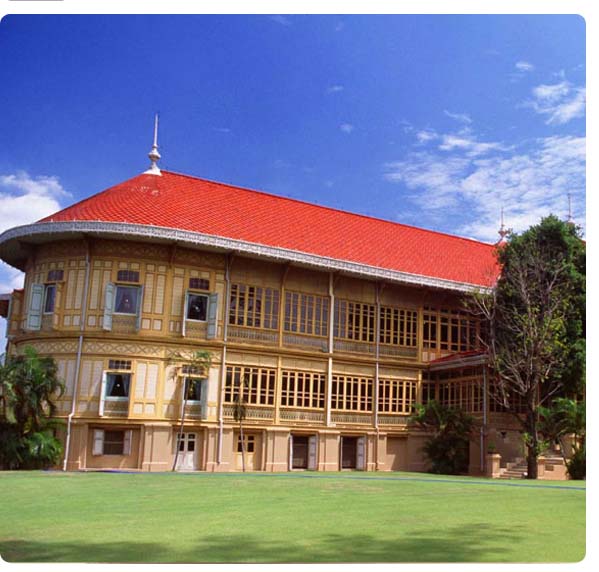
พิพิธภัณฑ์พระที่นั่งวิมานเมฆ

ตั้งอยู่บริเวณหลังพระที่นั่งอนันตสมาคม ในเขตพระราชวังดุสิต เป็นพระที่นั่งที่สร้างด้วยไม้สักทองทั้งหลัง เดิมตั้งอยู่บนเกาะสีชัง สร้างขึ้นในสมัยรัชกาลที่ 5 และได้ชะลอมาไว้ ณ สถานที่ตั้ปัจจุบัน เมื่อปี พ.ศ. 2444 ประกอบด้วยห้องต่างๆ 81 ห้อง ตัวอาคารมีคลองล้อมรอบ ภายในบริเวณร่มรื่น สวยงามมาก ภายในเขตพระราชวังดุสิตยังมีหมู่พระตำหนักอีก 11 องค์ที่ปัจจุบันใช้เป็นสถานที่จัดแสดงสิ่งของสำคัญต่างๆ ได้แก่

พิพิธภัณฑ์ศิลปาชีพ พระที่นั่งอภิเษกดุสิต พระบาทสมเด็จพระจุลจอมเกล้าเจ้าอยู่หัวมหาราชโปรดเกล้าฯ ให้สร้างขึ้น เมื่อปี พ.ศ. 2474 จุดเด่นที่สวยงามของพระที่นั่งองค์นี้ก็คือ ลายไม้ฉลุแบบสมัยพระนางเจ้าวิคตอเรียแห่งประเทศอังกฤษ ปัจจุบันปรับแต่งเป็นพิพิธภัณฑ์แสดงผลงานหัตถกรรมที่ประดิษฐ์ขึ้นโดยสมาชิกของมูลนิธิส่งเสริมศิลปาชีพ ในสมเด็จพระนางเจ้าฯ พระบรมราชินีนาถ ภายในพิพิธภัณฑ์มีงานหัตถกรรมหลากหลายให้ชม อาทิ เครื่องเงิน คร่ำ ผ้าทอ ผ้าปัก ถมเงิน ถมทอง งานประดับด้วยปีกแมลงทับ เป็นต้น
พิพิธภัณฑ์รถม้าพระที่นั่ง เป็นที่รวบรวมรถม้าพระที่นั่งโบราณซึ่งใช้ในสมัยรัชกาลที่ 5 รถม้าแต่ละคัน เคยร่วมในพระราชพิธีสำคัญต่าง ๆ มีความสง่าสวยงาม และมีคุณค่าทางประวัติศาสตร์
พระตำหนักสวนสี่ฤดู เคยเป็นพระตำหนักที่ประทับของสมเด็จพระศรีพัชรินทราบรมราชินีนาถ สมเด็จพระอัครมเหสีในพระบาทสมเด็จพระจุลจอมเกล้าเจ้าอยู่หัวมหาราช
นอกจากนี้ภายในเขตพระราชวังดุสิตยังมีอาคารที่จัดทำเป็นพิพิธภัณฑ์ต่าง ๆ ได้แก่ พิพิธภัณฑ์ภาพถ่ายฝีพระหัตถ์ พิพิธภัณฑ์นาฬิกาโบราณ พิพิธภัณฑ์ผ้าโบราณ พิพิธภัณฑ์เครื่องราชูปโภค และพระสาทิสลักษณ์ พิพิธภัณฑ์ภาพพระราชพิธี
พิพิธภัณฑ์เปิดให้เข้าชมทุกวัน (ยกเว้นวันหยุดนักชัตฤกษ์) ตั้งแต่เวลา 09.30–16.00 น. อัตราค่าเข้าชมพระที่นั่งวิมานเมฆ คนไทย ผู้ใหญ่ 75 บาท เด็ก 20 บาท ชาวต่างประเทศ 100 บาท หากต้องการเข้าชมเป็นหมู่คณะต้องทำหนังสือแจ้งล่วงหน้า สอบถามรายละเอียดเพิ่มเติม โทร. 0 2628 6300-9 website: http://www.vimanmek.com/


Vimanmek Palace

An outstanding example of 19th century architecture. While admiring the craftsmanship of the carpenters, you will travel back through time to gain a rare insight into the lifestyle of royalty.

Vimanmek Mansion, the principal building in the palace compound, was built for King Rama V on land he named The Dusit Garden located between Padung Krungkasem and Samsen canals. The completion was celebrated on March 27, 1901 and King RamaV took up residence until 1906. The mansion was originally his Summer Palace, the Munthaturaltanaroj Residence, on Sri Chang Island. It was dismantled and re-built at the present location under the supervision of HRH Prince Narissaranuwaddhiwongse.

The three-storey Vimanmek Mansion is the largest golden teak building in the world, built in an architectural style that reflects European influences. There are two right-angled wings, each 60 metres long and 20 metres high. The section where The King resided is octagonal and has four storeys. The mansion has 81 rooms, halls and ante-chambers.

Following King Rama V moving to Amporn Satarn Mansion in 1906, Vimanmek Mansion was un-occupied until 1925 when King Rama VI gave permission for his wife, HRH Indharasaksaji to take up residence there. She stayed there until his death.

For the next 50 years it was used as just a storage area for the Bureau of the Royal Household until 1982 when HRH Queen Sirikit initiated its restoration as a museum to commemorate King Rama V.

Today, there are 31 exhibition rooms. Exhibits include a silverware room, ceramic display room, glassware and ivory display. Some of the rooms have been preserved to retain the atmosphere of the earlier era, particularly the bedrooms, bathrooms and the Audience Chamber. Other buildings in the compound also house displays of various artifacts and precious art objects.

Location: Ratchawithi Road, Dusit District, Bangkok
How to get there : taking the bus Routes no. 12, 18, 28,56,70, 108, 515 and get off on Ratchawithi Road. or Ratchasima Road
Opening Hours : Open everyday from 9.30 am. to 3.30 pm. ( close on Public Hoildays)
Admission Fee : Baht 100. *If you have visited The Grand Palace on the same day you will have also received an entrance ticket to Vimanmek Palace which is valid.
Contact : Tel. 0 2628 6300-9
Website : www.vimanmek.com
Nearby Places/Attractions: Wat Benchamabophit (Marble Temple), Dusit Zoo, Anantasamakom Thron Hall, King Rama V Statue


พิพิธภัณฑสถานแห่งชาติ พระนคร

แต่เดิมสถานที่แห่งนี้เป็นวังหน้าของกรมพระราชวังบวรมหาสุรสิงหนาท โปรดเกล้าฯ ให้สร้างขึ้นพร้อมกับวังหลวง พระที่นั่งที่สำคัญ ได้แก่ พระที่นั่งศิวโมกขพิมาน พระที่นั่งพุทไธศวรรย์ พระที่นั่งอิศราวินิจฉัย ต่อมาในสมัยรัชกาลพระบาทสมเด็จพระจุลจอมเกล้าเจ้าอยู่หัว โปรดเกล้าฯ ให้จัดตั้งพิพิธภัณฑสถานแห่งชาติขึ้นที่ศาลาสหทัยสมาคม
เรียกว่า “มิวเซี่ยม” แล้วจึงย้ายมาไว้ที่วังหน้าของกรมพระราชวังบวรฯ ซึ่งบางส่วนกลายเป็นมหาวิทยาลัยธรรมศาสตร์ และบริเวณข้างเคียงมีโรงเรียนช่างศิลป์ วิทยาลัยนาฏศิลป์ และโรงละครแห่งชาติอยู่ในบริเวณเดียวกัน สิ่งที่น่าสนใจ นอกจากพิพิธภัณฑ์แล้วยังมีวัดบวรสถานสุทธาวาส ตั้งอยู่ภายในบริเวณวังหน้าใกล้กับโรงเรียนช่างศิลป์ วัดนี้เรียกกันว่า “วัดพระแก้ววังหน้า” พิพิธภัณฑสถานแห่งชาติจัดแสดงศิลปโบราณวัตถุต่างๆ มากมายอันเป็นมรดกทางวัฒนธรรมของไทยและชาติเพื่อนบ้าน พิพิธภัณฑ์ฯ แห่งนี้ ได้รับรางวัลอุตสาหกรรมการท่องเที่ยว ประจำปี 2545 รางวัลยอดเยี่ยมประเภทโครงการส่งเสริมและพัฒนาการท่องเที่ยว จากผลงานโครงการเผยแพร่ความรู้สู่ประชาชน เพื่อส่งเสริมให้รู้จักคุณค่าของวัฒนธรรมอันเป็นมรดกของชุมชนของตนเพื่อการท่องเที่ยว เปิดให้เข้าชมทุกวัน เว้นวันจันทร์-อังคาร และวันหยุดนักขัตฤกษ์ ตั้งแต่เวลา 09.00-16.00 น. อัตราค่าเข้าชม ชาวไทย 20 บาท ชาวต่างประเทศ 40 บาท สอบถามเพิ่มเติมได้ที่ โทร. 0 2224 1333


The National Museum

A visit to the National Museum reveals the history of Thailand And how people lived during the different periods. It gives you a view through the windows of the past. The National Museum, located on the opposite side of Sanam Luang to The Grand Palace, was established in 1887 by King Rama V. The foundation collection was previously stored at The Grand Palace. The original building was formerly the palace of a vice-ruler.


A visit to the National Museum reveals the history of Thailand And how people lived during the different periods. It gives you a view through the windows of the past.

The National Museum, located on the opposite side of Sanam Luang to The Grand Palace, was established in 1887 by King Rama V. The foundation collection was previously stored at The Grand Palace. The original building was formerly the palace of a vice-ruler.

King Rama VII placed it under the administration of the Royal Institute of Literature, Archeology and Fine Arts which has evolved to be the Fine Arts Department.

New buildings were constructed in 1967 and other historical buildings relocated to the museum grounds.

The Buddhaisawan Chapel was built in 1787 to enshrine a revered northern Buddha image called Phra Buddha Si Hing. The interior has exceptional murals, while the building itself is a fine example of Rattanakosin religious architecture.

Tamnak Daeng is another building that has been moved to the Museum. This Red House was originally the residence of an elder sister of King Rama I. Furniture and other items from early Bangkok times.

The National Museum collection encompasses a wide range of religious and secular art found throughout the country. Items from pre-historic times, through the Srivijaya, Dvaravati, Khmer Kingdoms and the Sukhothai, Ayutthaya and Rattanakosin periods of Thai history.

These include Neolithic tools, painted pots and bronze objects unearthed in the northeast. Thai Buddhist art exhibits feature images in stone, bronze and terracotta as well as illustrated scripture books manuscript cabinets and votive plaques.

The Museum also has a large collection of miscellaneous items such as Thai and Chinese ceramics, theatrical costumes, palanquins, weapons and assorted items used in royal households.

Guided tours are given free by volunteers in English and French starting at 9.30 a.m. on Wednesdays and Thursdays. Tours are also given in German on Thursdays and in Japanese on Wednesdays of the first & the third week of each month. Guided tours in some other languages can be arranged.

How to get there : The most enjoyable route is to take the BTS Skytrain to Taksin Station. From here take a Chao Phraya River Express boat to Tha Phrachan Pier. Walk straight from the pier to Sanam Luang Park and turn left past Thammasat University to the museum. By Bus No. 3, 6, 9, 15, 19, 30, 32, 33, 43, 53, 59, 64, 65, 70, 80, 84 Air Condition Bus No. 3, 6, 7, 38, 39, 80, 82, 91 Airport Bus No. A2

Opening hours : Wednesday to Sunday from 9.00 a.m. to 4.00 p.m.
Admission fee : 40 baht
Contact : The National Museum Bangkok Na Phrthat Rd., Phra Borommaharachawang Sub-district, Phra Nakorn District, Bangkok 10200
Tel : 0 2224 1333, 0 2224 1370 www.thailandmuseum.com
Nearby Places/Attractions: Grand Palace (Wat Phra Kaew), Phra Athit Road, Khaosan Road

พิพิธภัณฑสถานแห่งชาติ เรือพระราชพิธี


ตั้งอยู่ริมคลองบางกอกน้อยตรงข้ามสถานีรถไฟธนบุรี เป็นอู่เก็บเรือที่ใช้ในพระราชพิธีต่างๆ ตั้งแต่สมัยกรุงธนบุรี ถึงกรุงรัตนโกสินทร์ เรือเหล่านี้เป็นเรือขุดทั้งสิ้น เรือพระราชพิธีที่เก็บอยู่ได้แก่ เรือพระที่นั่งสุพรรณหงษ์ เรือพระที่นั่งอนันตนาคราช เรือพระที่นั่งเอนกชาติภุชงค์ เรือพระที่นั่งนารายณ์ทรงสุบรรณ และเรือพระที่นั่งอื่นๆ อีกหลายลำ เปิดให้เข้าชมทุกวันตั้งแต่เวลา 09.00-17.00 น. (ปิดช่วงเทศกาลวันหยุดปีใหม่และวันหยุดสงกรานต์) อัตราค่าเข้าชมชาวไทย 10 บาท ชาวต่างชาติ 30 บาท ค่าธรรมเนียมถ่ายภาพ 100 บาท วีดีโอ 200 บาท โทร. 0 2424 0004

การเดินทาง ใช้บริการรถโดยสาร สาย 79 503 507 509 511 จากฝั่งกรุงเทพฯ ข้ามสะพานพระปิ่นเกล้าฯ แล้วลงที่ป้ายรถโดยสารป้ายแรก (ตรงข้ามพาต้า) และเดินเท้าไป


Royal Barge National Museum

Royal Barge National MuseumThe Royal Barge Procession is one of the most spectacular events in the world. It is performed occasionally during the Tod Kathin Buddhist Festival when H.M. The King delivers new robes to the monks at Wat Arun. It was also seen by millions of viewers around the world when it was specially staged for the 2003 APEC Conference in Bangkok and broadcast live to the participating countries. These ornately decorated boats are maintained by the Royal Thai Navy and docked at The Royal Barge National Museum on Bangkok Noi canal on the Thonburi side.The most impressive and important boat is the Kings personal barge, Suphanahong which was built in 1911. It is 46 metres in length hewn from a single tree and covered with intricate gilt carvings and colourful pieces of glass. The design is representative of a mythical swan. The crew consists of 54 oarsmen who paddle in time to the rhythmic beat of a drummer. The Royal Barge fleet consists of 52 vessels. Each is a masterpiece of marine and traditional craftsmanship. They feature a variety of figureheads on their bows, including a sacred Garuda, Hanuman and the seven heads of Naga. In formation the fleet travels in rows five abreast and more than one kilometer from the leading barge to those at the rear. These are propelled by 2,082 specially trained naval personnel A visit to The Royal Barge National Museum will give you an insight into

04 กุมภาพันธ์ 2552

มิวเซียมสยาม พิพิธภัณฑ์การเรียนรู้

Museum Siam Discovery Museum


ตั้งอยู่ที่บริเวณท่าเตียน ถนนสนามไชย แขวงพระบรมมหาราชวัง เขตพระนคร กรุงเทพฯ ในอาคารเก่าที่เคยเป็นกระทรวงพานิชย์เดิม ตัวอาคารหลังนี้ได้รับรางวัลอนุรักษ์ศิลปะสถาปัตยกรรมดีเด่น ประจำปี พ.ศ.2549จากคณะกรรมาธิการอนุรักษ์ศิลปสถาปัตยกรรม สมาคมสถาปนิกสยามในพระบรมราชูปถัมภ์ การจัดแสดงในพิพิธภัณฑ์มีการใช้สื่อสร้างสรรทันสมัยน่าสนใจและสนุกสนาน อธิบายถึงความเป็นมาของประเทศไทย ทั้งด้านเชื้อสาย ศิลปวัฒนธรรม ขนบธรรมเนียมประเพณีจนมาเป็นเชื้อชาติไทยเหมือนทุกวันนี้ โดยมีการแบ่งเป็นโซนต่าง ๆ ตามลำดับด้วยการนำผู้เข้าชมร่วมไขปริศนาของดินแดนสุวรรณภูมิ และพาผู้ชมไปร่วมค้นหาคำตอบสำคัญด้วยตนเองว่า "เราคือใคร" และ "ความเป็นไทยหมายถึงอะไร"

พิพิธภัณฑ์แห่งนี้เป็นแหล่งเรียนรู้ทางด้านชาติพันธุ์วิทยา มานุษยวิทยาและสาขาอื่นๆ ที่เกี่ยวข้องกับสังคมไทยและเอเชียตะวันออกเฉียงใต้ เพื่อสร้างสำนึกรักและเข้าใจในประวัติความเป็นมาของผู้คน บ้านเมือง วัฒนธรรมและท้องถิ่นของตน ตลอดจนเชื่อมโยงความสัมพันธ์ในลักษณะเครือญาติกับประเทศเพื่อนบ้าน โดยใช้วิธีการจัดแสดงแบบใหม่ ผ่านสื่อเครื่องมือต่างๆ ที่ทันสมัย ทำให้ผู้เข้าชมสามารถมีส่วนร่วม เรียนรู้และเข้าใจเรื่องราวประวัติศาสตร์ของชาติไทยได้เป็นอย่างดี ภายในอาคารแบ่งเนื้อหาการจัดแสดงเป็น 17 ห้องหลัก ในรูปแบบ "เรียงความประเทศไทย" โดยแบ่งออกเป็น 3 ชั้น ตามห้องต่างๆ ชั้นแรก ประกอบด้วย ห้องที่นำเข้าสู่การจัดแสดง, เบิกโรง, ไทยแท้, ตึกเก่าเล่าเรื่อง และมีร้านขายของที่ระลึก ชั้นที่2 จัดแสดงเรื่องแผนที่ความยอกย้อนบนแผ่นกระดาษ, กรุงเทพฯ ภายใต้ฉากอยุธยา, ชีวิตนอกกรุงเทพฯ, แปลงโฉมสยามประเทศ, กำเนิดประเทศไทย, สีสันตะวันตก, เมืองไทยวันนี้และมองไปข้างหน้า ชั้นที่ 3 จัดแสดงหัวข้อเปิดตำนานสุวรรณภูมิ, สุวรรณภูมิ,พุทธิปัญญา, กำเนิดสยามประเทศ, สยามประเทศและสยามยุทธ์ ผู้เข้าชมจะได้รับความรู้และความเพลิดเพลินจากการเข้าชมแต่ละห้องจัดแสดง นอกจากนี้ยังมีการจัดกิจกรรมต่างๆ เพื่อการเรียนรู้สำหรับเยาวชนและผู้สนใจรักด้านพิพิธภัณฑ์

พิพิธภัณฑ์เปิดวันอังคาร-วันอาทิตย์ เวลา 10.00-18.00 น. (ไม่เว้นวันหยุดราชการ) ปิดวันจันทร์ ไม่เสียค่าเข้าชม สอบถามข้อมูลเพิ่มเติมโทร 0 2622 2599 โทรสาร 0 2225 2775 หรือ www.ndmi.or.th

ที่ตั้ง อยู่บริเวณท่าเตียน ถนนสนามไชย ติดกับโรงเรียนตั้งตรงจิตพณิชยการ และสถานีตำรวจพระราชวัง ห่างจากวัดโพธิ์ประมาณ 500 เมตร

การเดินทาง รถโดยสารประจำทาง สาย 3, 6, 9, 12, 47, 53, 82, 524 หรือเรือด่วนเจ้าพระยา ท่าราชินี หรือท่าเตียน แล้วเดินต่อประมาณ 150 เมตร

It is located on Sanam Chai Road in Phra Nakhon District, in the former building of the Ministry of Commerce. This building won an outstanding award of art and architecture preservation in 2006 from the committee on art and architecture preservation of the Association of Siamese Architects under the Royal Patronage of His Majesty the King (ASA).
The museum serves as a learning centre on ethnology, anthropology, and other fields related to Thai society and Southeast Asia, in order to instil consciousness and understanding of the Thai people in their history, nation, culture, and localities, as well as connect relative ties with neighbouring countries. New methods of a display with modern media have been applied to enable participation of visitors in learning and understanding historical stories of the Thai nation. The contents on display in the form of the ‘Essays on Thailand’ have been divided into 16 rooms in the three-storey building. The first floor exhibits rooms of ‘Immersive Theater’ and ‘Typically Thai.’ The second floor displays rooms of the ‘Map Room,’ ‘Bangkok, New Ayutthaya,’ ‘Village Life,’ ‘Change,’ ‘Politics and Communications,’ ‘Thailand and the World,’ ‘Thailand Today,’ and ‘Thailand Tomorrow.’ The third floor includes rooms of ‘Introduction to Suvarnabhumi,’ ‘Suvarnabhumi,’ ‘Buddhism,’ ‘Founding of Ayutthaya,’ ‘Siam,’ and the ‘War Room.’ Visitors will gain knowledge and enjoy themselves from visiting each exhibition room. In addition, learning activities are organised for youth and aficionados of museums.
The museum is open on Tuesdays to Sundays from 10.00 a.m. – 6.00 p.m. It is closed on Mondays. For further details, call Tel. 0 2622 2599, Fax: 0 2225 2775, or visit the website: www.ndmi.or.th
Location: on Sanam Chai Road, near Wat Pho (500 metre walking distance) and Phra Nakorn Police Station.
How to get there: taking public bus no. 3, 6, 9, 12, 47, 53, 82, 524 or taking taxi boat toTha Tien Pier then continue walking for 500 metres.

สยามโอเชี่ยนเวิร์ล

Siam Ocean World


เป็นอุทยานสัตว์น้ำที่ใหญ่ที่สุดในภูมิภาคเอเชียตะวันออกเฉียงใต้ ตั้งอยู่ในศูนย์การค้าสยามพารากอน ย่านสยามสแควร์ ใจกลางกรุงเทพฯ จัดแสดงสัตว์น้ำจากทั่วโลกจำนวนกว่า 30,000 ตัว 400 สายพันธุ์ รวมทั้งสัตว์น้ำที่หายากของโลก ในพื้นที่ถึง 10,000 ตารางเมตรหรือประมาณสนามฟุตบอล 2 สนาม ด้วยเทคโนโลยีที่ทันสมัยได้มาตรฐานโลก เพื่อให้เป็นแหล่งความรู้ความบันเทิงสำหรับเยาวชนและนักท่องเที่ยว และมีกิจกรรมสร้างความเพลิดเพลินสนุกสนานให้กับผู้ชมในช่วงเทศกาลพิเศษต่าง ๆ การจัดแสดงภายในแบ่งออกเป็นโซนต่าง ๆ ได้แก่ โซนแปลกประหลาดอัศจรรย์ มีสิ่งมีชีวิตที่แปลกตาน่าตื่นเต้นพิศวง โซนแนวปะการัง ตระการตากับปะการังทุกสายพันธุ์ทั่วโลก โซนกฎเหล็กเพื่อการอยู่รอด พบชีวิตที่ต้องป้องกันตัวเองให้อยู่รอดในธรรมชาติใต้น้ำ โซนแงกะพรุน โซนป่าดิบชื้น ฯลฯ สอบถามรายละเอียด ติดต่อ บริษัท สยามโอเชี่ยน เวิลด์ จำกัด โทร. 0 2687 2000 หรือที่เว็บไซต์ www.siamoceanworld.com


A new attractions in downtown Bangkok. Open in December 2005, Siam Ocean World will be the largest aquarium in Southeast Asia. With world-standard exhibits and features, the aqaruim comprises a 270-degree acrylic under ocean tunnel, a panoramic oceanarium with a 360-degree view through a 10.5 metre diametre fishbowl, an 8-metre deep reef tank and a rainforest display. More than 400 species or 30,000 marine animals including Penguins, Blue Ring Octopus, Gray Nurse Sharks, Elephant Nose Sharks, Leafy Sea Dragons and Giant Spider Crab can be seen.

open : daily from 9 a.m. to 4 p.m.
Admission : 450 baht for adults and 280 baht fro children (80-120 cm.height).
How to get there : taking sky train to Siam BTS Station or taking bus 73,16, 15, 79, 40, 54, 204
Contact : Siam Ocean World Tel: 0 2687 2000 Fax: 0 2687 2001
Website :
http://www.siamoceanworld.com/

อักษราหุ่นละครเล็ก Aksra Hun Lakon Lek at Aksra Theatre

Aksra Hun Lakon Lek at Aksra Theatre อักษราหุ่นละครเล็ก ( โรงละครอักษรา)

The various performances of the Thai Puppets together with Thai Orchestra Band.

โรงละครอักษรา ตั้งอยู่ที่ชั้น 3 อาคารคิงพาวเวอร์ คอมเพล้กซ์ ถนนรางน้ำ เขตราชเทวี โรงละครอักษราเป็นโรงละครขนาดกลางขนาด 600 ที่นั่ง ที่สุดของมนต์เสน่ห์มายาเหนือจินตนาการกลางใจเมือง ภายใต้บรรยกากาศตกแต่งที่รังสรรค์ด้วยแรงบันดาลใจจากศิลปะยุคบาโคก และวิจิตรด้วยลวดลายจากสถาปัตยกรรมและศิลปไทย พร้อมกับคุณภาพด้านเทคนิคโรงละครอย่างครบถ้วน นอกจากนี้ยังมี Scene Shop ร้านจำหน่ายสินค้าที่ระลึก และ Scene Bar จำหน่ายอาหารและเครื่องดิ่ม

ขณะนี้ทางโรงละคร จัดให้มีการแสดง “อักษราหุ่นละครเล็ก” ศิลปะการแสดงชั้นสูงที่หาชมได้ยาก ร่วมถ่ายทอดโดยคณะนักแสดงและหุ่นกว่า 110 ตัวในชุดการแสดงต่าง ๆ ผสมผสานท่วงทำนองเพลงอันวิจิตรจากคณะออเคสตร้าชั้นนำ บนฉากสุดตระการตา ด้วยเทคนิคแสง เสียง ณ “โรงละครอักษรา” โดยมีรอบการแสดงดังนี้ : อังคาร - ศุกร์ เวลา 19.00 น. เสาร์ และอาทิตย์ เวลา 13.00, 19.00 น. วันจันทร์งดการแสดง ค่าเข้าชมท่านละ 800 บาท สอบถามเพิ่มเติม โทร. 02 677 8888 ต่อ 5678 www.Aksratheatre.com การเดินทาง รถไฟฟ้าบีทีเอส สถานีอนุสาวรีย์ชัยสมรภูมิ หรือ รถเมล์สาย 73, 204 ลงที่ถนนรางน้ำ

Aksra Theatre is situated on 3rd floor of King Power Complex Building, Rangnam Road, Khet Ratchathewi. Aksra Theatre is a medium size theatre with 600 seats It is embellished with the majestic decoration that draws its essence from Thai traditional art and interior. It provides a fully and advanced equipped stage that can host spectacular performances and events. Attached to Aksra Theatre are Scene Shop, a souvenir shop and Scene Bar, a bar with a panoramic terrace.

At the present, Aksra Theatre organises the various performances of Thai Puppets together with Thai Orchestra Band. Combined with stage technique and classical dance, the elaborated scenes that tell diverse stories taken from Ramakien epic.

The show time: Tuesday- Friday: 19.00 hrs Saturday-Sunday: 13.00, 19.00 hrs. Closed on Monday The admission fee is 800 baht/ person More information please contact tel. 02 677 8888 ext. 5678 www.Aksratheatre.com

How to get there: Taking BTS Skytrain and getting off at Vuctory Monument Station and then walking to Rang Nam Road within 10 mins or Taking Bus no. 73, 204 and getting off near by Rang Nam Road

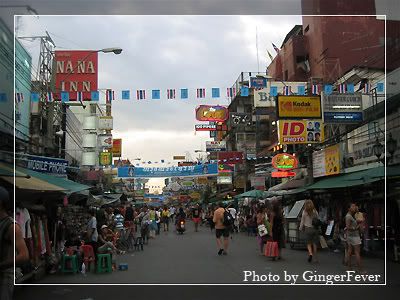
ถนนข้าวสาร


Khao San Road
ตั้งอยู่ใกล้ย่านบางลำพู และถนนราชดำเนินกลาง เป็นแหล่งที่พักราคาประหยัดยอดนิยมของนักท่องเที่ยวต่างชาติและเป็นจุดนัดพบนักเดินทางทั่วโลกที่มาเที่ยวกรุงเทพฯ ตลอดระยะทาง 500 เมตร กิโลเมตรของถนนข้าวสาร เรียงรายด้วยเกสท์เฮ้าส์ ร้านอาหาร ร้านขายของที่ระลึก ร้านเสื้อผ้า และบริการท่องเที่ยวต่าง ๆ มากมาย นอกจากนี้ถนนข้าวสารยังเป็นสถานที่จัดงานเทศกาลสงกรานต์ยอดนิยมของกรุงเทพฯ

Where the worlds young travellers meet.
Khao San Road is a favourite crossroads for the young travellers on a budget. It has evolved over the last two decades from just one small hostel providing low-budget accommodation become one of the worlds most well-known destinations. It has been featured in many movies and television documentaries.
During the day, Khao San Road is the scene for back-packers looking for a cheap room while others are arranging transport to their next destination in Thailand or overseas. Some will be just chatting with friends over a cup of coffee or a bowl of noodles.